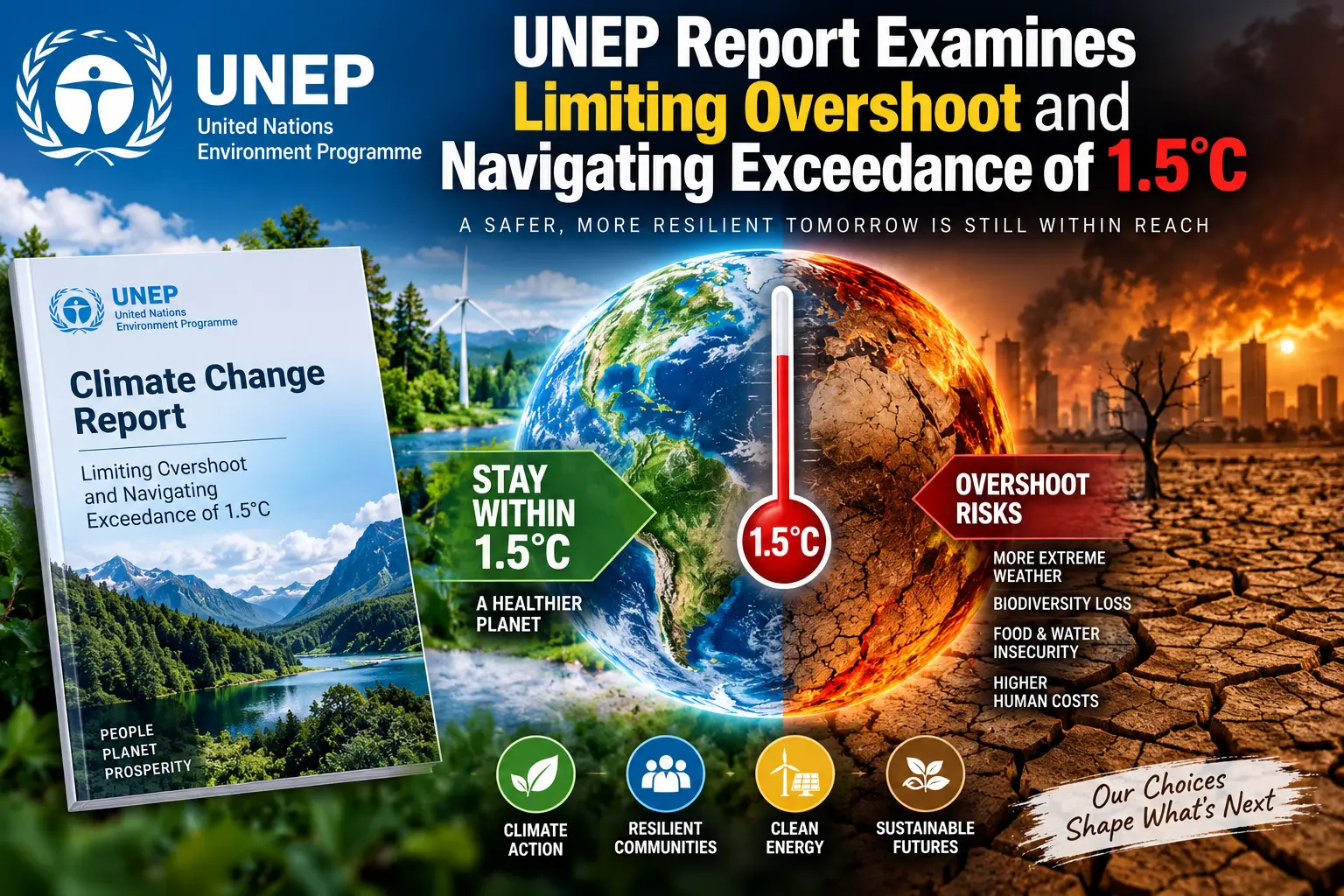
The publication of a landmark environmental assessment by the United Nations Environment Programme has brought the stark reality of global climate trajectories into sharp focus. The report, entitled 'Limiting Overshoot', warns that the international community is virtually certain to breach the critical 1.5°C warming threshold established under the Paris Agreement within the next few years. This finding marks a pivotal moment for global climate policy, forcing governments, scientific institutions, and civil society to confront the immediate necessity of managing a temporary or prolonged exceedance of safe temperature limits. Understanding the mechanics of this projected overshoot is essential for evaluating the severe ecological disruptions already underway and the unprecedented policy adjustments required to restore planetary stability.
Accelerating Global Warming Rates Highlighted in the United Nations Environment Programme Assessment
Human-induced warming has continued to accelerate, standing currently close to 1.4°C above pre-industrial levels. According to observational data highlighted in the assessment, global temperatures are rising at an alarming rate of approximately 0.25°C per decade. Under current global policy frameworks, cumulative warming is projected to reach approximately 2.6°C by the turn of the century. Even if all existing nationally determined contributions and long-term net-zero targets were implemented with absolute optimal efficiency, temperature increases would still peak at roughly 1.8°C above pre-industrial benchmarks before any stabilization could occur.
This trajectory underscores the widening gap between stated international ambitions and actual emission reductions. While the Paris Agreement aimed to hold warming well below 2°C while pursuing efforts to limit the increase to 1.5°C, the sheer momentum of accumulated greenhouse gases in the atmosphere makes crossing the lower boundary practically unavoidable in the near term. Consequently, the discourse within environmental science has shifted from mere prevention of the threshold breach to managing the multifaceted complexities of an overshoot, peak, and subsequent decline pathway.
Widespread Coral Bleaching and Accelerated Glacier Loss Across Global Ecosystems
Crossing the 1.5°C threshold is far from a purely numerical milestone; it carries profound, potentially irreversible consequences for global ecosystems. The assessment details how vulnerable natural systems are already buckling under current temperature pressures. Between 2023 and 2025, more than 80 percent of tropical coral reefs experienced severe bleaching across at least 83 countries and territories, threatening marine biodiversity and the livelihoods of millions who depend on coastal reef ecosystems.
Terrestrial ice reserves are suffering similarly catastrophic declines. The report notes that more than 40 percent of total global glacier loss recorded since the 1970s occurred within the single decade spanning from 2015 to 2024. These vanishing glaciers destabilize regional water supplies, accelerate sea-level rise, and diminish the planet's capacity to reflect solar radiation. Such widespread ecological degradation demonstrates that every fraction of a degree in warming inflicts escalating damage, reinforcing the urgency of deploying aggressive adaptation measures alongside mitigation strategies.