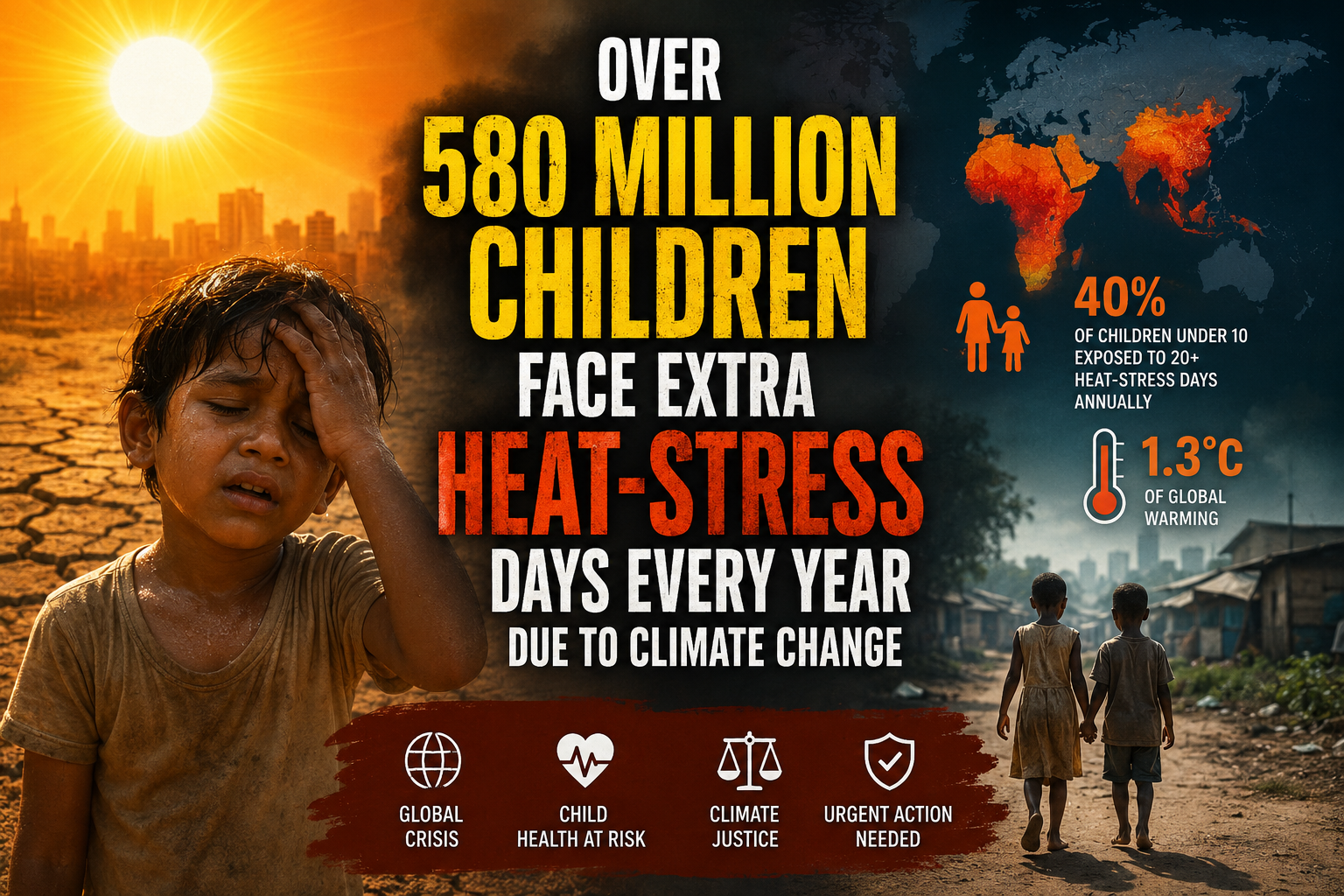
A major attribution study has revealed that more than 40 percent of children under the age of 10 worldwide are enduring at least 20 additional heat-stress days every year as a result of anthropogenic climate change. This finding underscores a planetary crisis that disproportionately threatens younger populations. As global temperatures continue to rise from a present-day baseline of 1.3 degrees Celsius of warming, the convergence of extreme heat and humidity presents a public health challenge. Understanding the precise scale of this exposure is essential for policymakers aiming to safeguard future generations against mounting environmental hazards.
Science Advances Attribution Study Links Climate Models and Demographic Data
Published in the journal Science Advances, the research combines climate models with demographic data to evaluate how age groups and geographical areas experience hazardous meteorological conditions. The investigation defines a heat-stress day as any period during which the indoor wet-bulb globe temperature exceeds 28 degrees Celsius. Under these conditions, the human body struggles to cool itself effectively through perspiration, elevating the risk of severe heat exhaustion, dehydration, and mortality. The analysis indicates that children up to the age of nine face greater exposure to such dangerous, humid heat globally than any other demographic cohort.
South Asia and West Africa Bear the Greatest Childhood Heat Exposure Burdens
Geographical disparities within the study highlight regional vulnerabilities driven by expanding populations and high proportions of young inhabitants. Low-latitude territories across south Asia, southeast Asia, and west Africa are recording the most concentrated childhood exposures to extreme thermal stress. For instance, individuals residing in Côte d'Ivoire currently experience 112 heat-stress days annually, with roughly half of those occurrences attributed directly to human-induced global heating. By contrast, countries with aging demographics and cooler temperate climates, such as Germany, register 0.1 heat-stress days per year under current climatic conditions. Lead authors emphasize that these imbalances raise questions of climate justice, as children in developing nations bear the heaviest burdens despite contributing the least to historical greenhouse gas emissions.
Urban Heat Islands and Microclimate Variations Complicate Long-Term Child Health Projections
While the macro-level data provides a clear warning, analytical uncertainties persist regarding local microclimate variations and urban heat-island compounding effects. Cities often absorb and retain solar radiation at higher rates than surrounding rural areas, potentially exacerbating the thermal burden on urban children. Furthermore, researchers note that the precise long-term physiological and developmental health trajectories for youngsters enduring chronic early-life thermal stress remain incompletely understood. These scientific knowledge gaps complicate efforts to project lifetime morbidity rates and design targeted urban interventions. Nevertheless, the findings build upon prior warnings from the same research team indicating that over half of children born in 2020 will face unprecedented lifetime exposure to intense heatwaves.