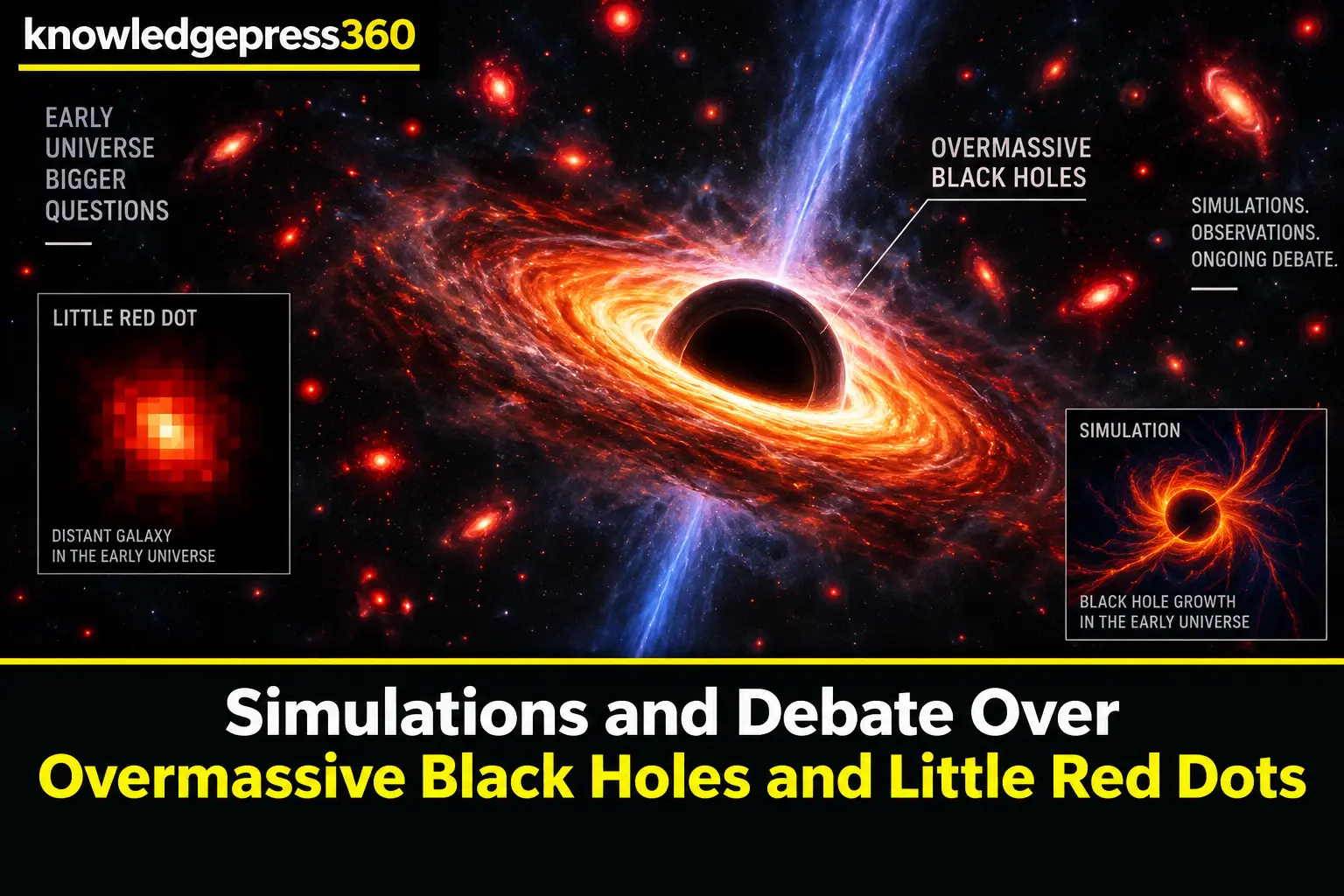
Recent discoveries made possible by the James Webb Space Telescope have radically reshaped our understanding of cosmic history, forcing astrophysicists to rethink how supermassive black holes formed in the early universe. Among the most puzzling discoveries are compact, intensely red sources scattered throughout high-redshift space, which exhibit blinding infrared spectra and luminosities that rival entire galaxies. Their inferred masses appear far too large for standard cosmological timelines, challenging long-held assumptions about stellar and galactic evolution. However, groundbreaking radiation-hydrodynamic simulations published in September 2026 offer a compelling theoretical framework, suggesting that these anomalous celestial bodies can be accounted for by natural mechanisms in the early cosmos. As researchers continue to debate whether these sources represent rapid black hole seed formation or an entirely unique class of astronomical phenomena, the scientific community stands on the brink of resolving one of modern astrophysics' most persistent enigmas. Understanding these objects is essential for mapping the evolutionary trajectory of the universe's most massive gravitational titans.
Unveiling Little Red Dots With JWST
Ever since the James Webb Space Telescope began transmitting its deepest infrared imagery of the early universe, astronomers have been confronted by a population of unusual celestial objects [1, 2]. Dubbed little red dots due to their compact angular dimensions and crimson spectral signatures, these sources shine with astonishing brilliance across vast cosmological distances [1, 2]. Initial analyses revealed that their calculated black hole masses vastly exceeded local scaling relations, creating a profound theoretical crisis that led some investigators to label them universe breakers [1]. These compact configurations initially seemed to defy standard models of cosmic growth, as conventional timelines could not easily account for how such massive structures could emerge less than a billion years after the Big Bang [1, 2]. The sheer abundance of these dots in early imaging fields confirmed they were not mere statistical anomalies but a prominent population demanding rigorous physical explanation .