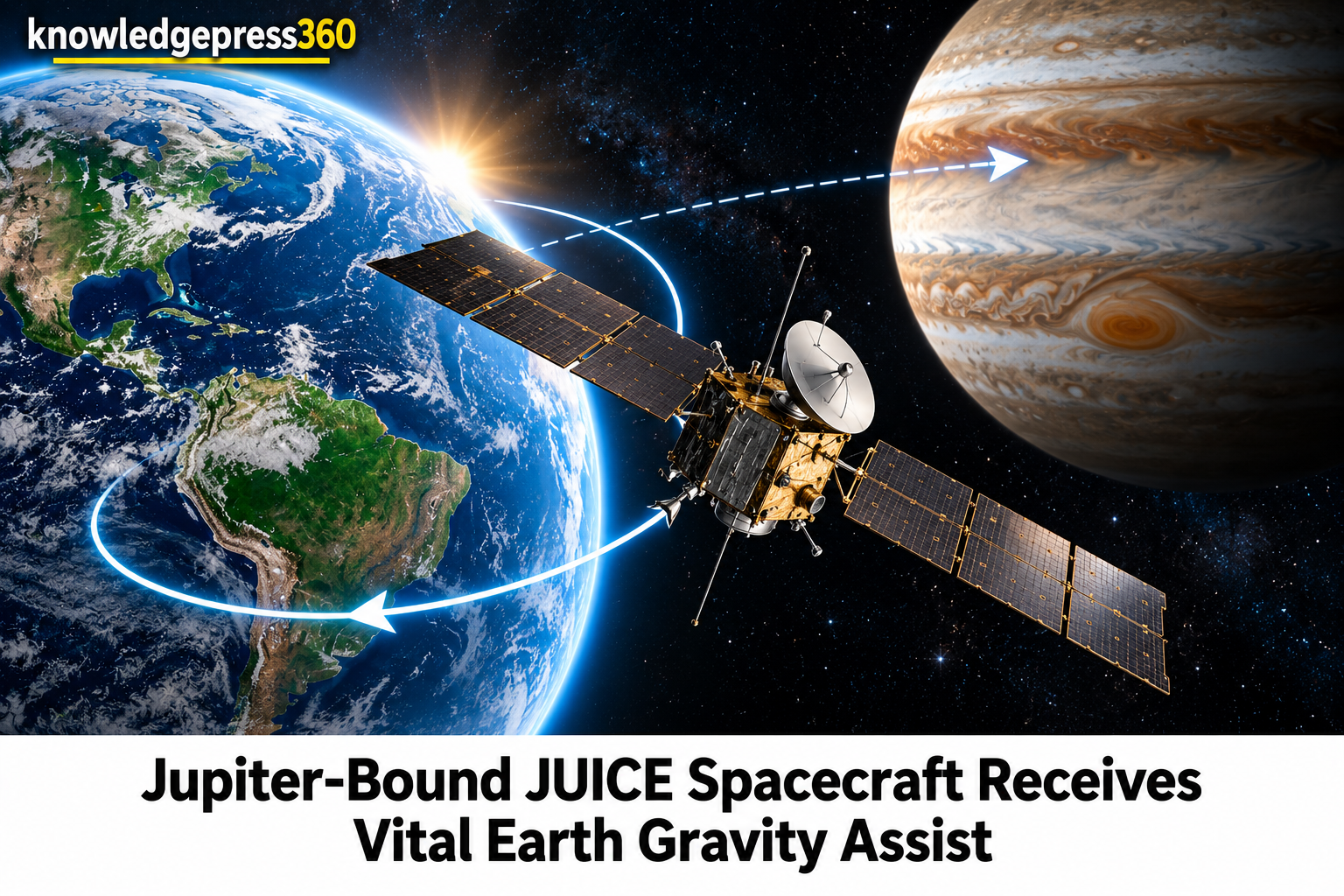
The European Space Agency's ambitious Jupiter Icy Moons Explorer probe has successfully executed a close planetary rendezvous, swinging past our home world to harvest crucial momentum for its deep space voyage. This carefully managed celestial slingshot represents a major operational milestone in the multi-year interplanetary mission, reducing the heavy reliance on onboard propellant required to reach the outer solar system. By harnessing the planet's gravitational pull, mission controllers are able to redirect the probe toward the Jovian system efficiently, ensuring that complex science instruments retain enough fuel to complete their eventual investigations of the distant ice-covered moons. Navigating these narrow cosmic corridors demands pinpoint accuracy, making each gravitational interaction a high-stakes test of flight dynamics and automated spacecraft guidance.
Planetary Slingshot Over Indian Ocean
The spacecraft completed its scheduled flyby on Monday, September 28, skimming past the surface at a close distance while travelling high above the Indian Ocean. During its closest approach, the probe came within 5,370 miles or 8,640 kilometres of the planet, executing a precise trajectory adjustment that deflected its flight path by roughly 20 degrees. This gravitational interaction delivered an impressive velocity increase of approximately 3.5 kilometres per second, translating to a substantial speed boost of around 7,830 to 8,000 miles per hour. Project scientists noted that the operational complexity of this encounter was considerably lower than previous maneuvers, affording teams a rare opportunity to rotate the chassis and point onboard sensors toward both Earth and the Moon for calibration and scientific observation.
Multi-Year Interplanetary Journey
Launched originally in April 2023, the expedition relies entirely on a sequence of planetary flybys to build the immense momentum needed for its final destination. Because a direct flight path to Jupiter would demand an unfeasible quantity of chemical propellant, flight controllers designed a clever shortcut through the inner solar system. The spacecraft previously performed a pioneering combined lunar-Earth flyby in August 2024 to adjust its energy levels, followed closely by a Venus flyby in August 2025 that bent its orbit and provided additional acceleration. Every leg of this intricate celestial choreography has been meticulously calculated to compensate for the extreme distances involved in exploring the outer planets, ensuring stability across every phase.
Managing Minor Trajectory Variations
Despite the resounding success of the recent flyby, navigating an interplanetary probe past orbital environments requires constant vigilance and micro-adjustments. Flight controllers must continually account for minor trajectory deviations or fuel adjustments needed to keep the spacecraft precisely aligned with its long-term timetable. Furthermore, passing through congested orbital shell regions populated by active satellites and space debris demands rigorous tracking and precautionary maneuvering. Although current models indicate that the probe remains in pristine health and perfectly on course, mission specialists maintain continuous telemetry monitoring to address any unexpected anomalies immediately.