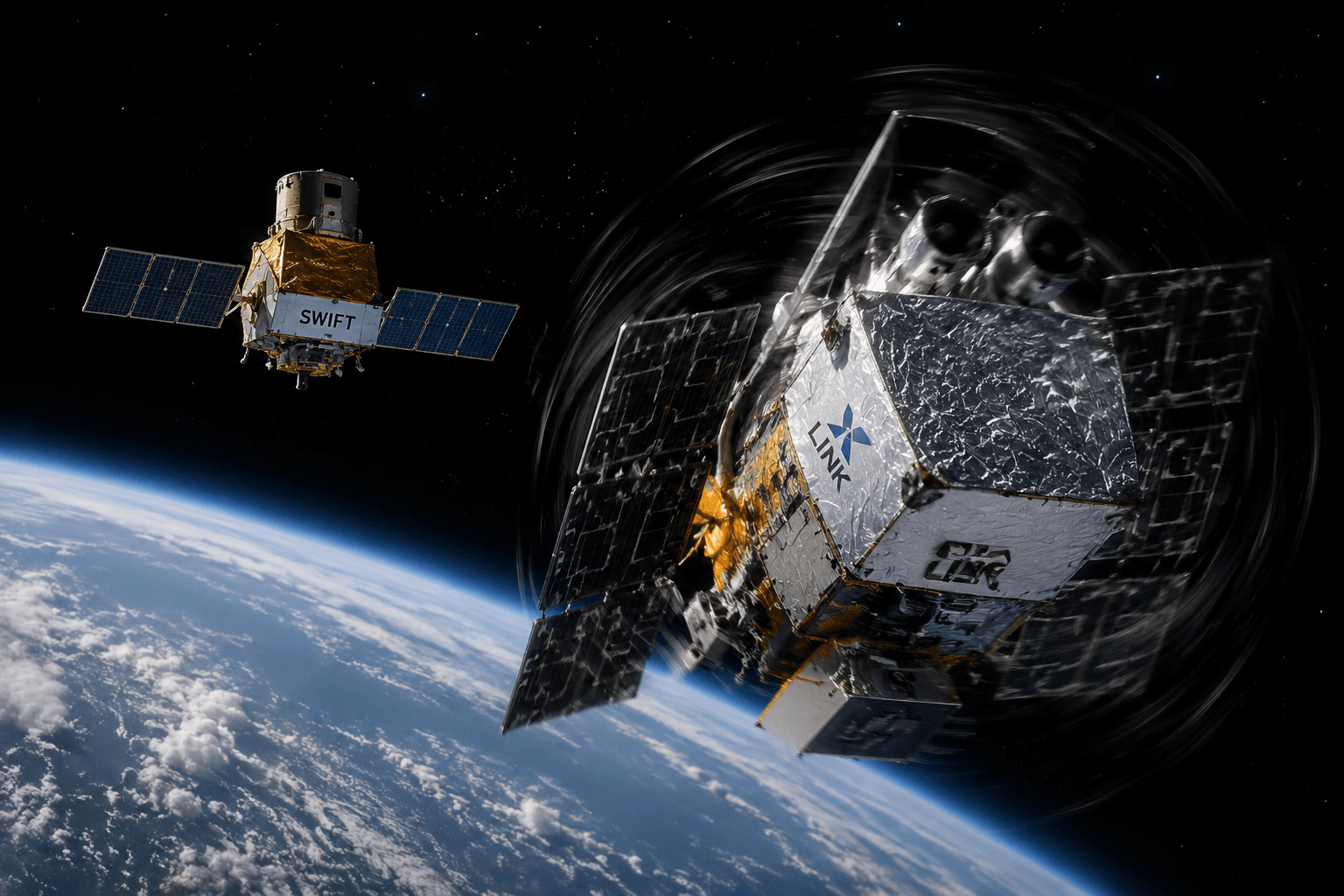
A high-stakes orbital rescue mission designed to safeguard NASA's Swift space telescope has encountered a severe crisis after the interceptor spacecraft lost stability and began spinning out of control. The unexpected malfunction has thrown institutional space science and commercial servicing initiatives into uncertainty, triggering an urgent race by engineering teams to regain command of the tumbling vehicle before it becomes a total loss.
The initiative centers on the LINK spacecraft, a specialized private vehicle dispatched to provide an essential altitude boost and operational life extension for the aging Swift observatory. Operating in low Earth orbit requires precise mechanics and flawless execution, yet during the critical transit phase, the rescue craft experienced an acute anomaly. Telemetry data confirmed that the vehicle lost its orientation bearings and entered an uncontrolled spin, immediately jeopardizing the entire intervention strategy and casting doubt on the future productivity of a major astrophysical asset.
Commercial partnerships have increasingly become the backbone of modern space exploration, offering cost-effective maintenance for institutional science missions that otherwise face premature retirement. However, this shift introduces complex operational dependencies. When a primary public asset relies on a secondary private vehicle for survival, any technical failure cascades rapidly through the mission architecture. The current crisis highlights the razor-thin margins of error inherent in commercialized orbital mechanics, where hardware anomalies can transform a routine servicing run into a critical salvage operation.
Details surrounding the precise trigger for the malfunction remain sparse, reflecting the fast-moving and opaque nature of aerospace troubleshooting. Engineers from both institutional and private sectors have initiated emergency recovery protocols, attempting to upload corrective software patches and command sequences to halt the rotation. Differing accounts from technical observers outline various potential recovery trajectories, though the exact mechanical or software root cause has yet to be definitively confirmed by official channels.
As troubleshooting efforts continue, the immediate focus remains on telemetry recovery and stabilization maneuvers. The success or failure of these remote interventions will determine not only the fate of the rescue craft itself but also the long-term operational viability of NASA's Swift mission. Observers across the scientific community are closely monitoring updates from mission controllers to see if the tumbling spacecraft can be salvaged from orbit.