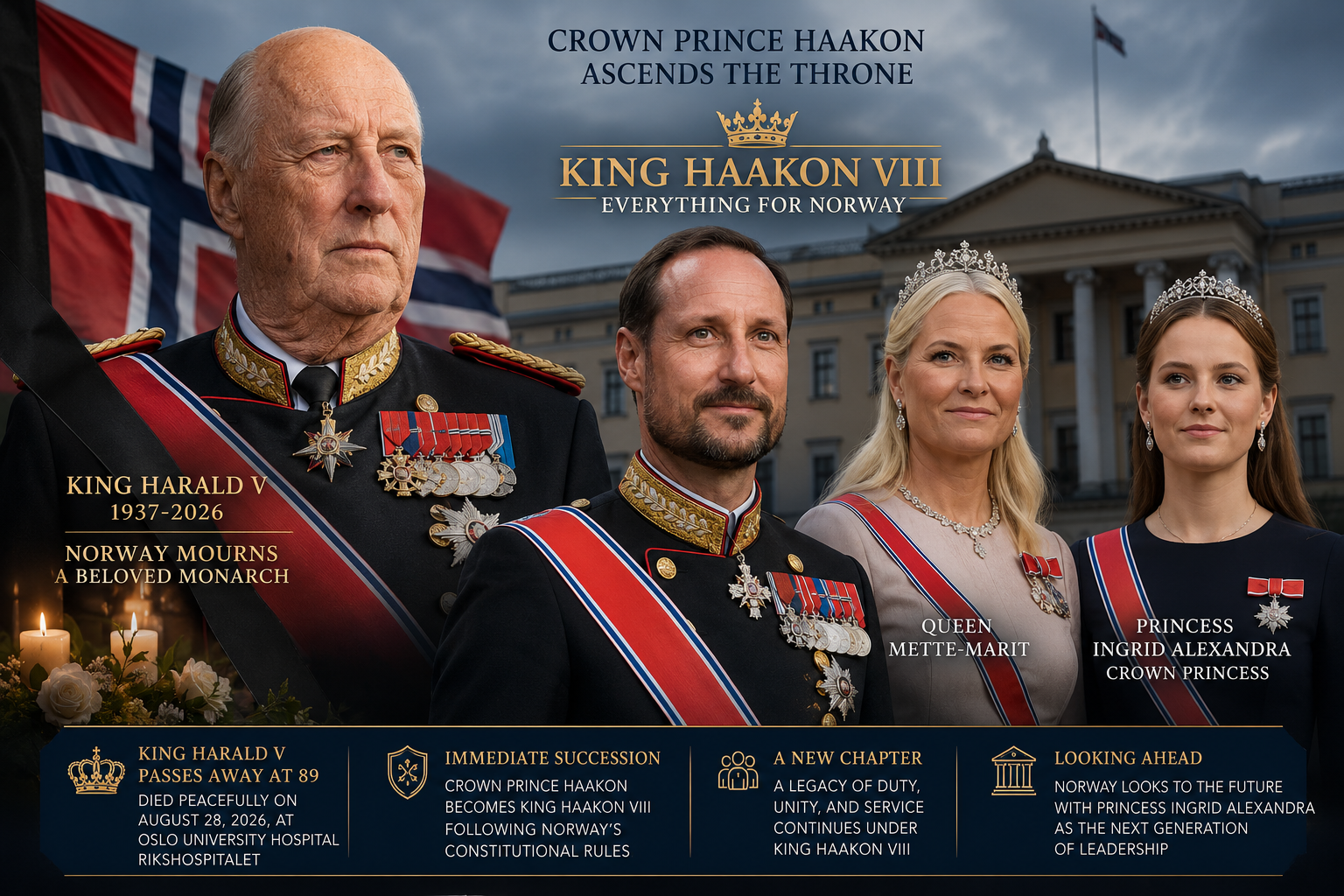
Norway has entered a solemn period of national mourning following the death of King Harald V, who passed away peacefully at the age of 89. The monarch died early on Friday, August 28, 2026, at 6:35 a.m. at Oslo University Hospital Rikshospitalet, according to an official statement from the Royal House of Norway. As Europe's oldest reigning monarch, King Harald V leaves behind a legacy of modernization, warmth, and steady leadership spanning more than three decades. His passing marks the end of an era for the Scandinavian nation, immediately propelling Crown Prince Haakon to the throne and ushering in a new chapter for the royal house amidst both public affection and modern governance challenges.
Medical Care and Passing of King Harald V at Oslo University Hospital Rikshospitalet
The late monarch had been admitted to Oslo University Hospital Rikshospitalet on August 17, 2026, after experiencing a deterioration in his health. Medical bulletins from the Royal House confirmed that he had been receiving cortisone treatment for hemolytic anemia, which led to fluid accumulation, alongside targeted antibiotics for a bacterial blood infection. Despite interventions and the implantation of a permanent pacemaker in 2024, his condition grew increasingly critical during his final weeks, prompting expressions of deep concern from across the country. Tributes immediately poured in from international leaders and Nordic royal families, celebrating a king who dedicated his reign to uniting the Norwegian public following his accession on January 17, 1991.
Immediate Succession of Crown Prince Haakon as King Haakon VIII
Under Norway's constitutional rules of succession, 53-year-old Crown Prince Haakon immediately assumed the throne as King Haakon VIII. Maintaining a proud tradition established when Norway regained its independence in 1905, the new sovereign chose the personal motto "Everything for Norway," mirroring the historic pledges of his father, grandfather, and great-grandfather. Alongside his ascension, his wife, Crown Princess Mette-Marit, became Queen Mette-Marit, while their oldest child, Princess Ingrid Alexandra, stepped forward as the new crown princess and direct heir to the throne. King Haakon VIII is no stranger to the responsibilities of head of state, having frequently served as regent during his father's previous health absences.
Public Relations Challenges and Institutional Continuity
King Haakon VIII ascends to the monarchy at a juncture defined by both deep-seated constitutional continuity and distinct public relations hurdles. While the Norwegian monarchy plays a largely symbolic and unifying role alongside the elected parliament, the royal family has faced rigorous public scrutiny in recent years. These challenges include public discussions surrounding Crown Princess Mette-Marit's past associations with the late sex offender Jeffrey Epstein and criminal legal issues involving family members. Navigating these delicate social currents while preserving the institution's traditionally high public standing will form an immediate priority for the new king and the broader royal establishment.