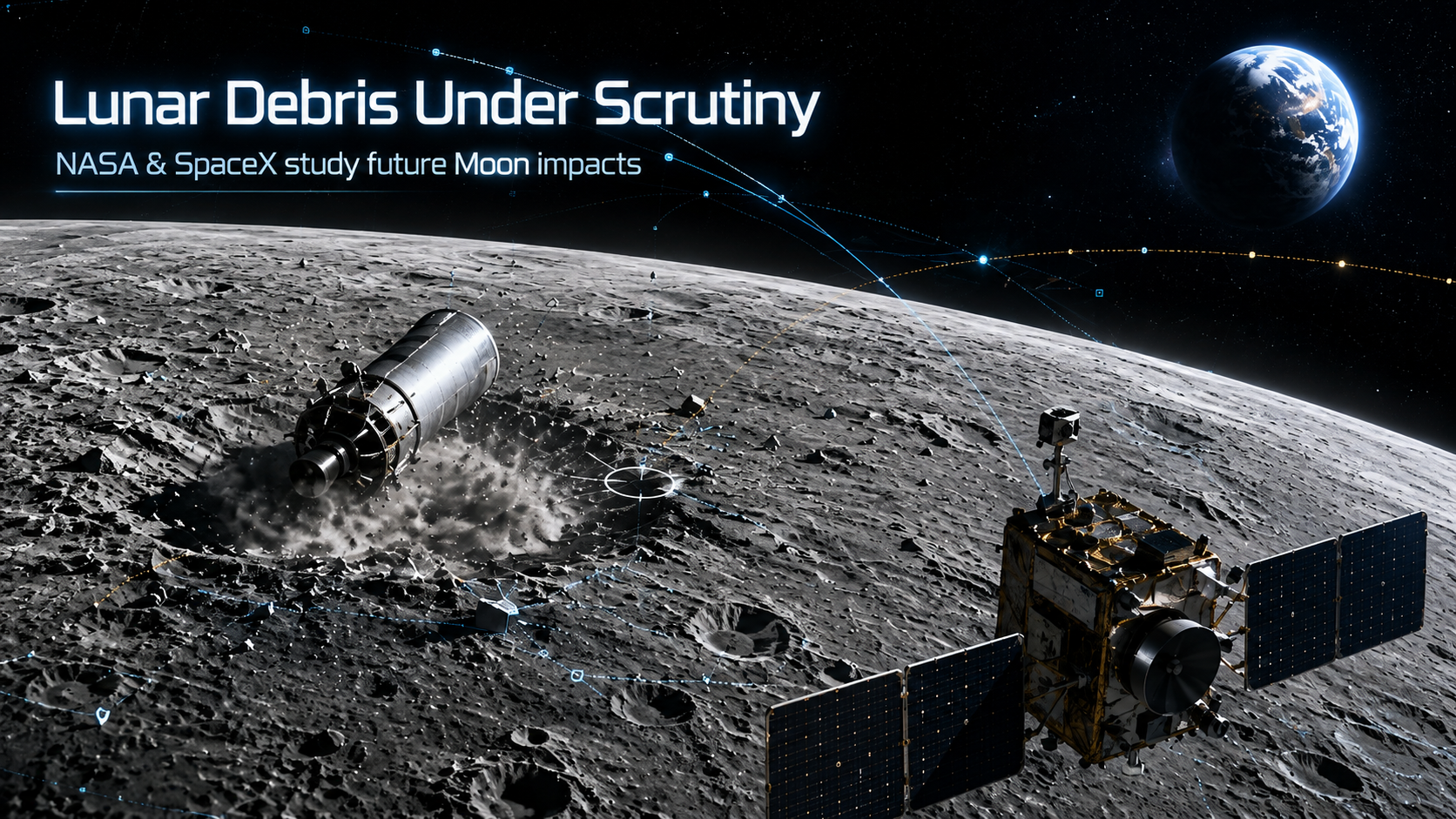
The rapid expansion of cis-lunar exploration has transformed the space between Earth and the Moon into a bustling operational frontier. Yet this surge in traffic brings an escalating environmental cost, drawing sharp focus to the accumulation of orbital debris and spent hardware. As commercial and institutional missions multiply, space agencies and private aerospace developers face mounting pressure to manage the permanent remnants of deep-space voyages. At the forefront of this shift, NASA and SpaceX have initiated dedicated studies to formulate engineering and operational solutions that prevent future upper-stage rocket bodies from colliding with the lunar surface.
For decades, spent upper stages were largely treated as disposable after completing their primary propulsion duties, often left to drift in unpredictable solar orbits or follow uncontrolled decay paths. The physical reality of cis-lunar mechanics means that many of these massive metal cylinders eventually cross paths with the Moon. While these impacts happen far from Earth, they leave lasting scars on the lunar topography and complicate the long-term management of the lunar environment. The joint focus by NASA and SpaceX on preventive measures marks a decisive shift from passive observation to active stewardship of the broader Earth-Moon system, acknowledging that the space domain requires sustainable practices just like terrestrial environments.
This emerging concern was underscored on August 5, 2026, when a spent SpaceX Falcon 9 upper stage struck the Moon near Einstein Crater at roughly 2.43 kilometres per second. The stage had launched two commercial lunar landers in January 2025 before remaining in cislunar space. South Korea's Danuri lunar orbiter subsequently captured before-and-after images of the impact area, revealing a newly formed crater and disturbed lunar terrain. Scientists are using observations of the event to study impact dynamics, ejecta behaviour and the potential hazards posed by artificial debris as activity around the Moon increases.
Despite these proactive steps, significant uncertainties remain regarding the precise technologies and regulatory frameworks that will ultimately govern upper-stage disposal. Developing propulsive manoeuvres to redirect spent stages away from the Moon requires reserve propellant, which directly trades off against payload capacity. Aerospace engineers must weigh the economic and technical costs of carrying extra fuel against the long-term imperative of keeping cis-lunar space clean. Furthermore, international consensus on lunar environmental standards is still in its infancy, leaving open questions about how global actors will coordinate debris mitigation efforts as traffic intensifies.
Looking ahead, the aerospace community must monitor official updates from both NASA and SpaceX as they outline concrete engineering frameworks for upper-stage disposal. At the same time, the scientific findings returned by Danuri following the August 5 impact will provide empirical baselines for how artificial debris interacts with the lunar regolith. These dual tracks of technological innovation and empirical observation will shape the regulatory and operational guidelines for decades of upcoming lunar exploration.