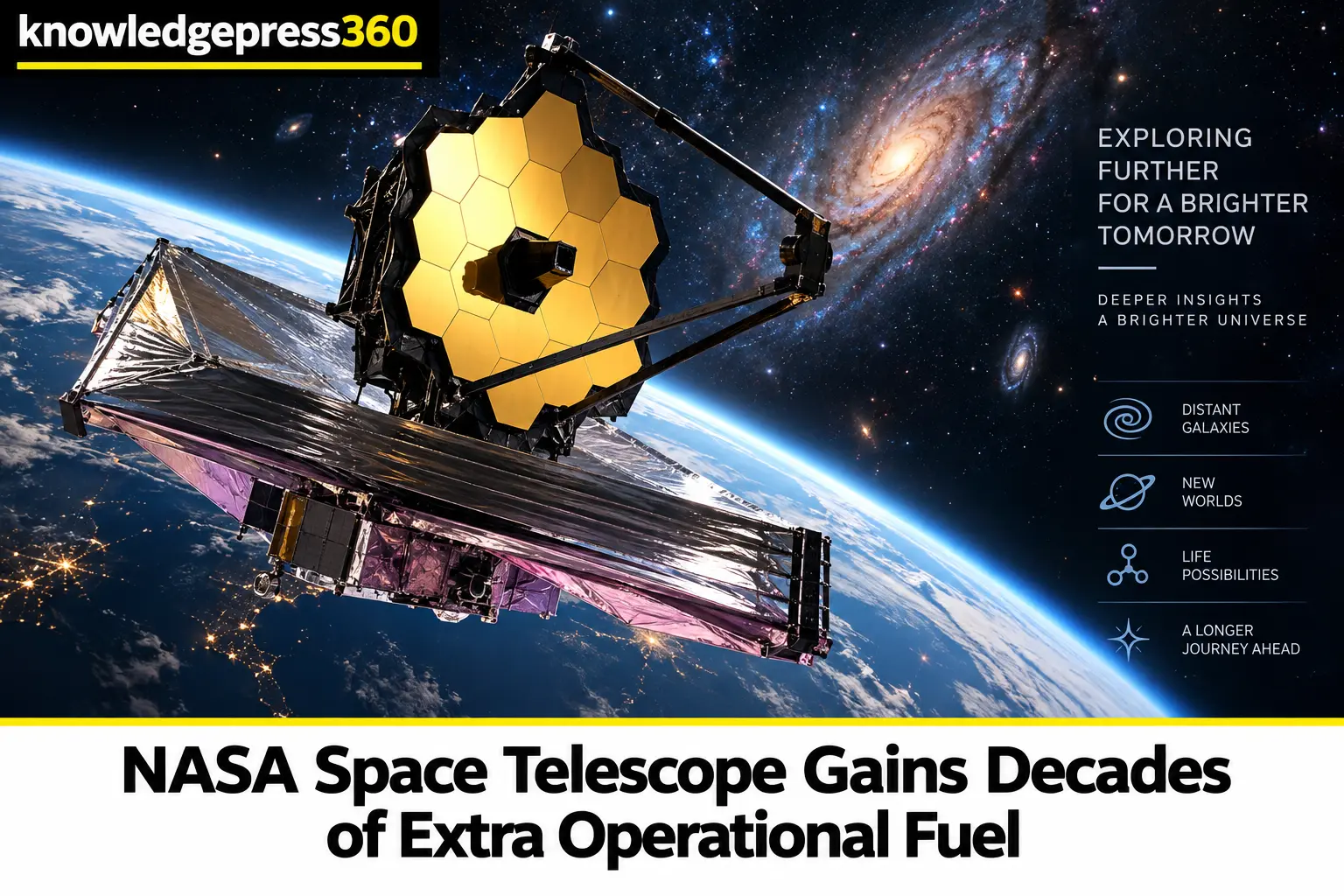
The search for answers regarding dark energy, dark matter, and distant exoplanets has received an unexpected boost. When NASA launched the Nancy Grace Roman Space Telescope, mission planners anticipated a standard operating lifespan governed by strict propellant limits. However, an extraordinarily precise opening manoeuvre and favourable mass margins have dramatically altered the trajectory of the mission. By consuming only a fraction of its allocated fuel during its initial journey phase, the observatory has unlocked the mathematical possibility of more than two decades of active science operations. This unexpected engineering windfall transforms a routine orbital adjustment into a landmark milestone for deep-space astronomy, promising unprecedented observational continuity.
Precision Burn Saves Critical Reserves
Spacecraft dispatched toward distant orbital outposts such as the Sun-Earth Lagrange 2 region must navigate minute discrepancies in initial velocity. Because tiny velocity variances compound into major positional shifts over millions of kilometres, engineers traditionally design conservative propellant budgets to absorb launch-dispersion uncertainties. For the Roman Space Telescope, flight controllers initially budgeted 441 pounds, or 200 kilograms, of propellant for the very first mid-course correction burn scheduled immediately after departure.
When the thrusters fired on August 31, the outcome far exceeded standard mission models. The manoeuvre consumed roughly 40 pounds, or 18 kilograms, accounting for less than ten percent of the allocated reserve. Furthermore, navigation data confirmed that the adjustment was executed with an impressive accuracy rate exceeding ninety-nine percent. This single efficient burn immediately preserved approximately 182 kilograms of propellant, instantly converting standard engineering contingency margins into long-term mission capability.
Launch Mass Benefits and Savings
The dramatic extension of the telescope operational horizon stems from multiple compounding factors rather than a single fortunate burn. The foundation of this expanded propellant reserve was established well before liftoff, when the observatory successfully launched aboard a SpaceX Falcon Heavy from the Kennedy Space Center on August 30, 2026. Mission designers had originally budgeted fuel allowances based on a conservative maximum spacecraft mass of 21,605 pounds, or 9,800 kilograms.
To the pleasant surprise of the engineering team, the completed observatory weighed in at a significantly lighter 17,760 pounds, or 8,056 kilograms. This notable reduction allowed technicians to fully load the propellant tanks prior to departure rather than restricting fuel volume to meet tighter weight caps. When combined with the massive savings secured during the initial trajectory correction, these structural mass efficiencies have fundamentally rewritten the mission longevity calculations.