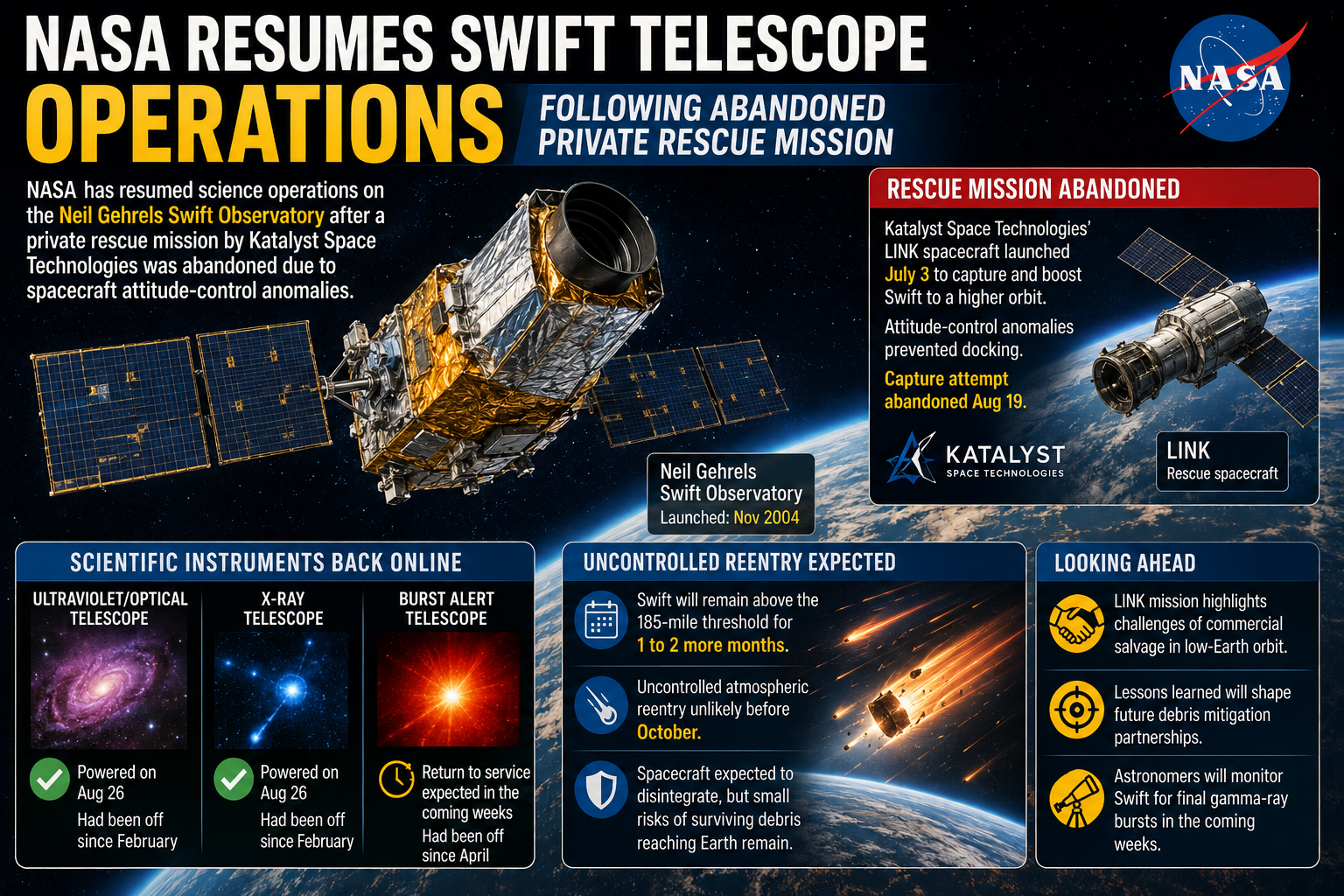
The Neil Gehrels Swift Observatory has officially resumed science operations after a pivotal shift in mission strategy forced by an aborted commercial rescue attempt. Operating in low-Earth orbit since November 2004, the multi-wavelength space telescope had its instruments powered down earlier in the year to reduce atmospheric drag and extend its operational lifespan. This conservation mode was triggered when heightened solar activity caused the spacecraft to sink toward Earth much faster than mission planners had originally anticipated. With an ambitious private salvage operation ultimately falling short of its primary objective, engineers have pivoted to extracting remaining scientific value from the venerable observatory before its inevitable atmospheric reentry.
Katalyst Space Technologies Rescue Bid Fails After Launch Anomalies
To combat the rapid orbital decay driven by solar-induced atmospheric expansion, NASA turned to the commercial sector for a novel solution. In September 2005, the space agency awarded Arizona-based Katalyst Space Technologies a $30 million contract to design, construct, and launch a robotic spacecraft named LINK. The primary mandate of the mission was to rendezvous with Swift, physically capture the observatory, and boost it to a safer, higher-altitude orbit. Katalyst operated on an accelerated schedule to meet the urgent orbital deadline, culminating in the launch of the LINK spacecraft on July 3 aboard a Northrop Grumman Pegasus rocket.
However, the mission encountered severe technical complications shortly after clearing Earth's atmosphere. The LINK spacecraft developed persistent attitude-control issues that crippled its ability to accurately manage its orientation and execute the complex orbital maneuvers required for docking. Following weeks of troubleshooting, NASA and Katalyst jointly announced on August 19 that the capture attempt had been officially abandoned. Rather than abandoning the mission entirely, Katalyst repurposed the spacecraft to perform alternative proximity operations to test in-orbit servicing technologies, leaving the Swift telescope without a commercial safety net.
Ultraviolet Optical And X Ray Instruments Resume Scientific Observations
Following the collapse of the re-boost strategy, the mission team adjusted its priorities to bring core instruments back online. On Wednesday, August 26, operators successfully powered on the Ultraviolet/Optical and X-ray telescopes. These instruments had been dormant since February to minimize electrical power consumption and optimize the spacecraft profile against atmospheric drag. Meanwhile, preparations remain underway to restore the third onboard instrument, the Burst Alert Telescope, which had been deactivated in April to allow precise solar panel positioning for drag reduction. Engineers anticipate returning the Burst Alert Telescope to active data collection within the coming weeks, allowing Swift to resume its traditional role as a rapid-response tool for tracking short-lived cosmic outbursts.