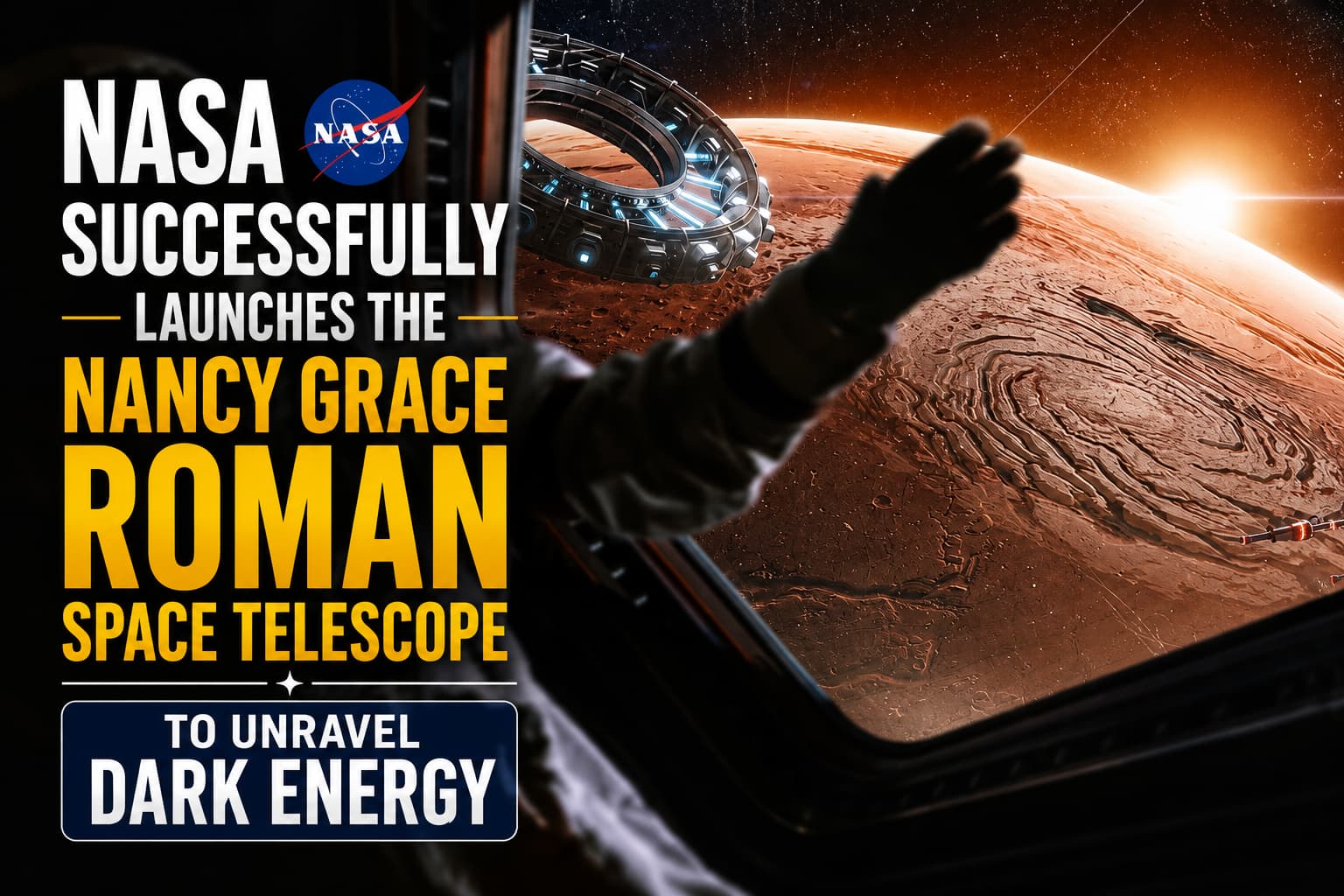
The successful August 30, 2026, liftoff of the Nancy Grace Roman Space Telescope from NASA's Kennedy Space Center marks a transformative chapter in observational cosmology. Powered by a SpaceX Falcon Heavy rocket, this flagship observatory is designed to peer deeper into the cosmos than ever before, offering unprecedented clarity on the invisible forces that shape our universe. As astronomers face persistent questions surrounding cosmic expansion, the deployment of this advanced hardware brings humanity closer to answering foundational mysteries about dark energy, dark matter, and the potential habitability of distant exoplanets.
SpaceX Falcon Heavy Liftoff from Kennedy Space Center Initiates Mission
The Nancy Grace Roman Space Telescope departed Earth at 7:35 a.m. local time on August 30, 2026, roaring away from NASA's Kennedy Space Center in Florida atop a SpaceX Falcon Heavy rocket. Named in honour of Nancy Grace Roman, widely remembered as NASA's first chief astronomer and a pivotal architect of the Hubble Space Telescope, the newly deployed observatory represents the culmination of decades of strategic planning. Unlike Hubble, which remains in low-Earth orbit, the Roman Space Telescope is travelling towards a distant vantage point orbiting the Sun, placing it in a thermal and gravitational environment similar to that of the James Webb Space Telescope.
Infrared Capabilities and Mirror Design Expand Sky-Mapping Horizons
At the technological heart of the mission is the largest infrared digital camera ever constructed, paired with a 2.4-metre primary mirror originally engineered for a different application in national aerospace infrastructure. This optical architecture grants the observatory an extraordinary field of view, enabling it to survey roughly one hundred times more sky in a single snapshot than Hubble can achieve. Because cosmic expansion stretches ancient light into redder infrared wavelengths that are routinely blocked by Earth's atmospheric envelope, spaceborne instruments are essential. By combining high angular resolution with sweeping panoramic views, the telescope is engineered to chart billions of galaxies across cosmic time, detect thousands of distant supernovas, and catalogue millions of stars and planets across the Milky Way.
Investigating Dark Energy and Complementing Global Observatories
The mission forms the final pillar in a trio of modern cosmological instruments, operating in concert with the European Space Agency's Euclid spacecraft launched in 2023 and the ground-based Vera C. Rubin Observatory inaugurated in Chile during 2025. Together, these facilities aim to dissect the 95 percent of the universe composed of dark matter, which acts as a gravitational scaffolding, and dark energy, the repulsive driver behind accelerating cosmic expansion. Furthermore, researchers plan to scrutinise the atmospheres of alien worlds to identify potential conditions for habitability.