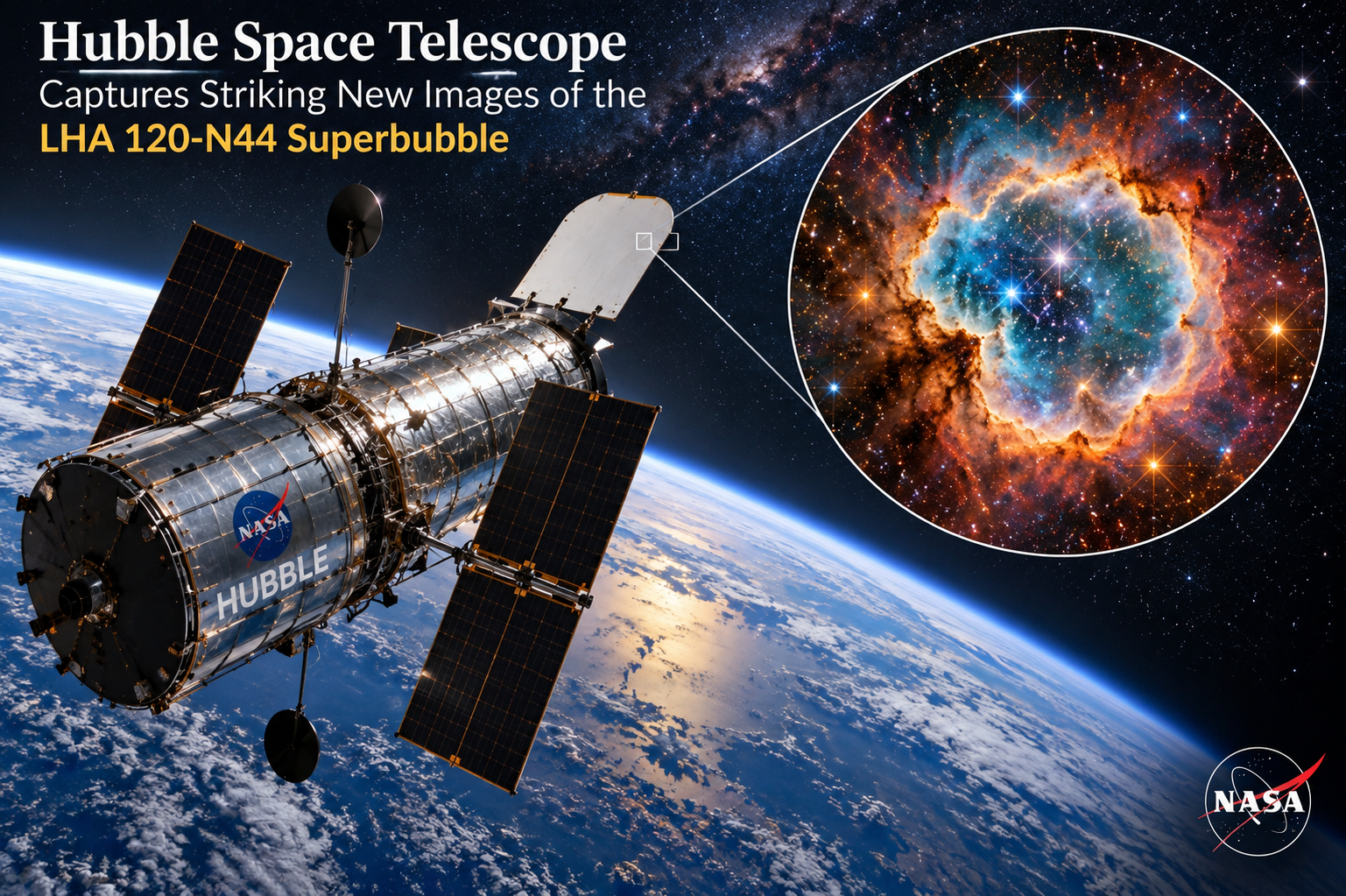
The Hubble Space Telescope has once again opened a window into the cosmos, returning imagery of a massive cosmic phenomenon located beyond our Milky Way. Astronomers have turned their attention toward a nebula superbubble known as LHA 120-N44, or simply N44, situated within the Large Magellanic Cloud. This capture showcases the details of deep space while providing researchers with a laboratory to examine the life cycles of stars. By peering into this distant stellar nursery, scientists aim to answer questions regarding how massive star clusters shape their surrounding environments and drive galactic evolution.
Unveiling the Vast Cosmic Void in the Dorado Constellation
Located approximately 160,000 light-years away from Earth, the N44 complex resides within the southern constellation of Dorado, inside one of our closest galactic neighbours. The feature of the released imagery is a central void that measures around 210 by 140 light-years across, nested within a broader glowing nebula complex spanning roughly 1,000 light-years. This emission nebula glows due to the ionization and subsequent cooling of hydrogen gas, which is energized by radiation from massive stars situated nearby.
Astrophysicists explain that this immense cavity was likely carved out by a combination of powerful stellar winds and explosive supernovae generated by massive stars residing at its core. These energetic processes effectively blew away the surrounding primordial gas, sweeping material outward to form a dense and dusty outer shell. The resulting perimeter now acts as a compressed boundary where new generations of stars are actively being forged, creating a contrast between the hollowed-out interior and the stellar nurseries lining the edges.
Surveying Hundreds of Thousands of Stars Within N44
Beyond the visual impact of the central cavity, the observational data gathered by Hubble represents a census of stellar demography. Researchers examining the cluster have catalogued nearly 500,000 stars situated in and around N44. Among this population, astronomers have identified approximately 30,000 pre-main-sequence stars, representing celestial bodies that have not yet ignited nuclear fusion within their dense cores.
This high concentration of developing stars transforms N44 into a site for studying stellar formation and evolution. The interplay between the deaths of older, massive stars and the birth of younger stellar neighbours illustrates a cycle of renewal. The compressed gas shell serves as a ground where gravitational forces routinely overcome internal pressures, forcing cold gas clouds to collapse into dense knots that will eventually spark into fully fledged stars.
Unresolved Mysteries in Stellar Evolution and Age Variance
Despite the data provided by high-resolution space telescope observations, uncertainties remain regarding the precise timeline and mechanics governing star formation within superbubbles. Astronomers continue to examine the exact duration and physical mechanisms that occur between the initial collapse of cold gas clouds and the moment nuclear fusion officially ignites in newborn stars. Pinpointing these critical transition periods remains essential for accurate modelling of galactic ecosystems.