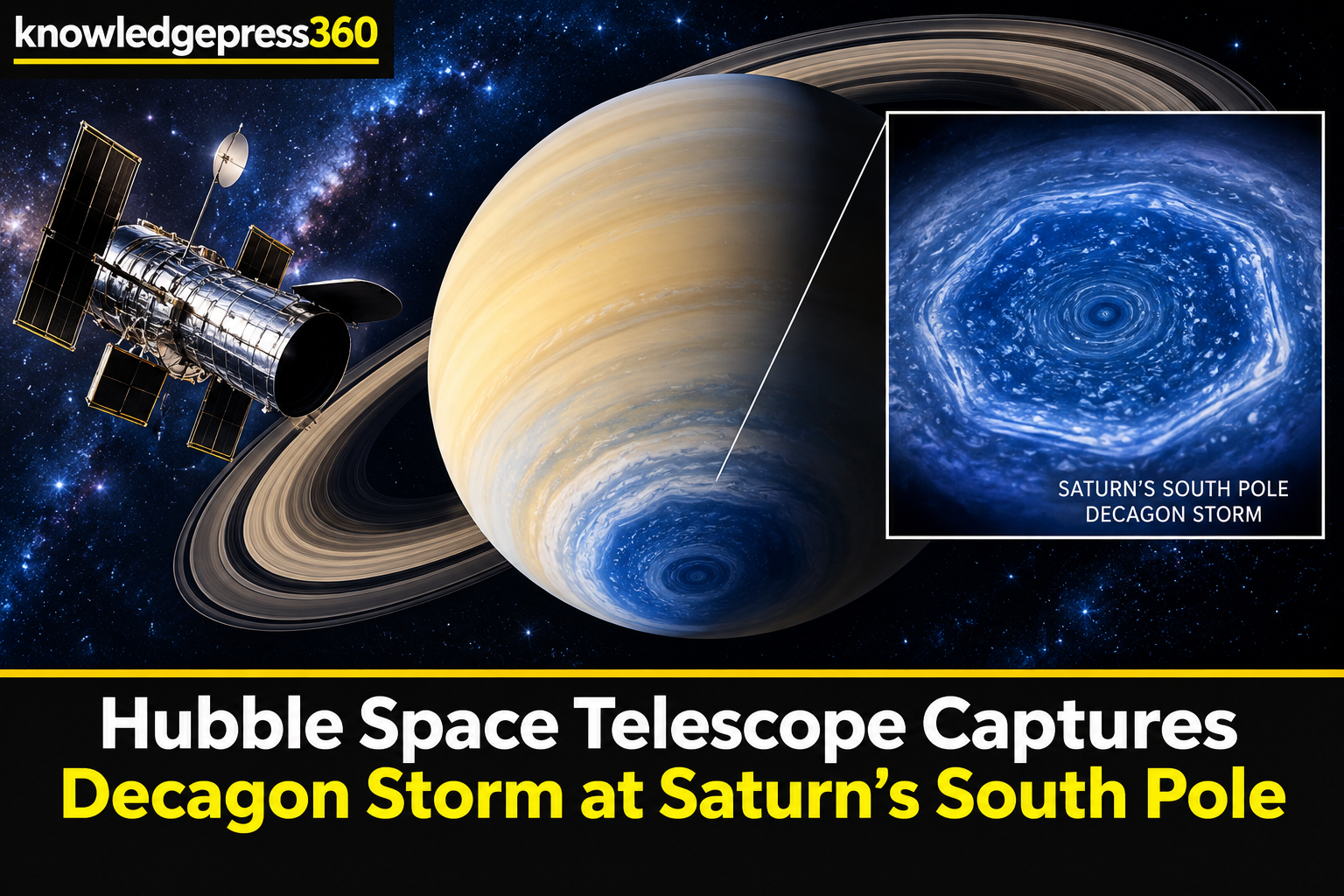
Astronomers working with the NASA/ESA Hubble Space Telescope have uncovered a colossal ten-sided atmospheric wave, or decagon, encircling Saturn's south pole. This newly revealed geometric feature serves as a southern counterpart to the famous six-sided hexagon that has dominated views of Saturn's north pole for decades. Because Saturn's extreme axial tilt and lengthy orbit hide its polar regions for extended periods, the south pole was effectively out of useful view from Earth between 2012 and 2023. This fresh discovery provides researchers with a rare window into the formation and evolution of massive planetary weather systems in real time, expanding our understanding of fluid dynamics in gas giant atmospheres.
Discovery of the Ten-Sided Wave by Professional and Amateur Teams
The trail toward identifying this massive southern structure began with ground-based observations by dedicated amateur astronomers across 2024 and 2025. Keen observers noticed a faint, wavy atmospheric pattern near the planet's southern hemisphere and alerted the scientific community. Prompted by these hints, professional researchers turned to high-resolution archives from the Hubble Space Telescope's Outer Planet Atmospheres Legacy program. Upon reviewing past imagery, scientists located the decagonal pattern faintly present in 2023 before it grew significantly more pronounced in subsequent years.
Led by Agustín Sánchez-Lavega of the University of the Basque Country, alongside colleagues such as Amy Simon and Mike Wong, the team detailed their findings in Science Advances. Precise measurements indicate that the structure spans approximately 104,250 miles across, with individual sides measuring roughly 10,425 miles apiece. This scale is immense enough to swallow multiple Earths laid end to end. Researchers also determined that the decagon is not merely a superficial cloud feature. Instead, data analysis reveals that the ten-sided wave is embedded deeply within an eastward jet stream and penetrates multiple vertical layers of Saturn's atmosphere.
Contrasting the New Southern Decagon With the Northern Hexagon
While Saturn's north pole has boasted a stable, long-lived hexagon for over forty years, the newly discovered southern decagon appears to be a relatively recent phenomenon. The northern geometric pattern has remained remarkably constant since its initial detection by Voyager spacecraft, serving as a classic benchmark for planetary meteorology. In contrast, the southern decagon's recent emergence offers an unprecedented chance to witness a complex polygonal storm system develop and evolve from an early stage.
Previous missions, including the Cassini spacecraft that orbited Saturn from 2004 to 2017, recorded warm polar vortices and individual cyclones at the south pole during its early mission phase, but observed no permanent polygonal jet matching the north. The return of favorable viewing geometry has allowed modern telescopes to detect shifts in apparent position when viewed through different wavelength filters, confirming the deep vertical structure of the southern waves. This duality between the two poles presents planetary scientists with unique comparative laboratories to study how similar atmospheric conditions produce strikingly different geometric outcomes.