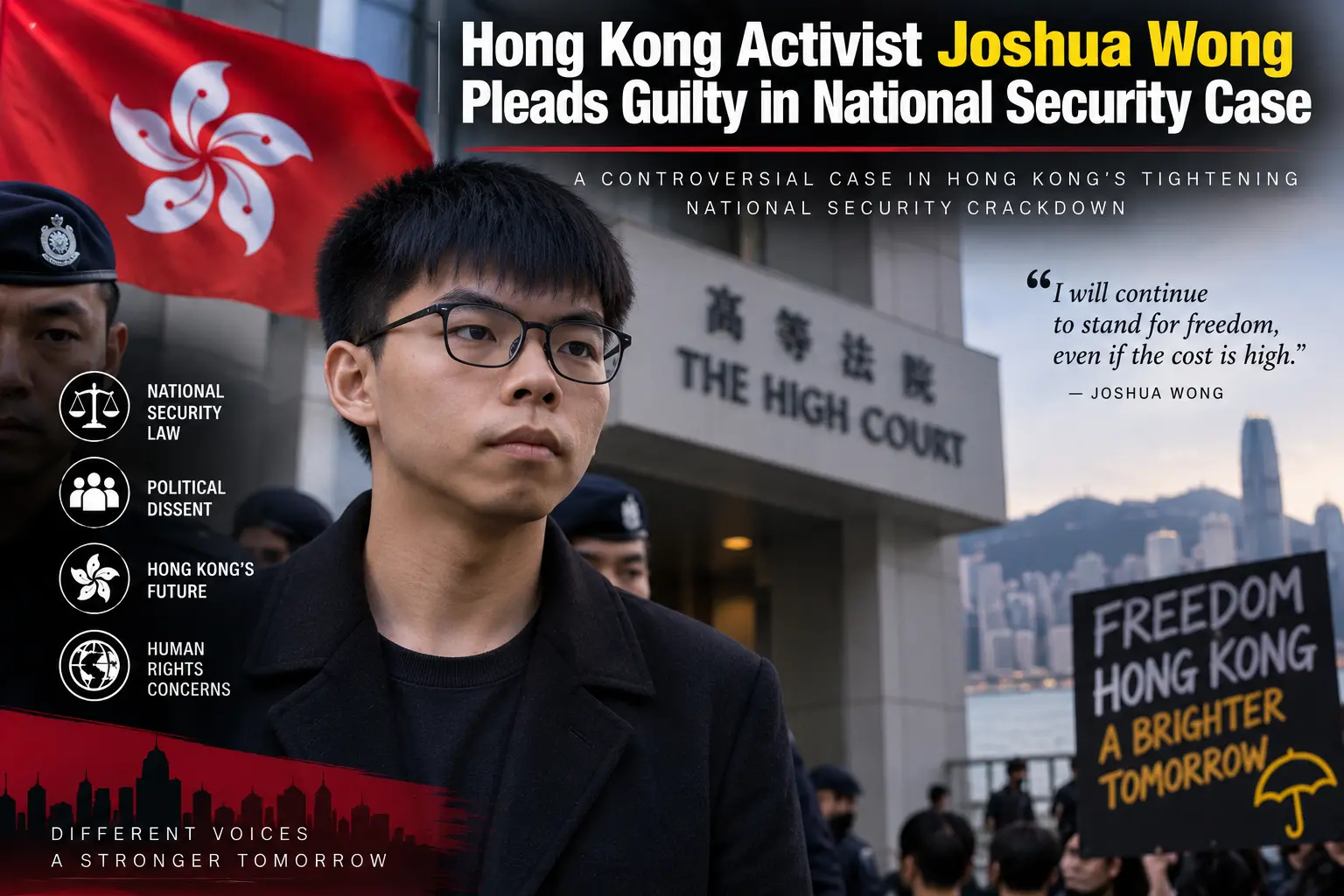
Prominent Hong Kong pro-democracy campaigner Joshua Wong has entered a guilty plea to a charge of conspiring to collude with foreign forces, marking a significant escalation in the ongoing legal actions targeting the territory's dissident figures. The development underscores the severe legal constraints facing political opposition in the region under the sweeping national security legislation introduced by Beijing. As the judiciary weighs the gravity of the accusations, the case highlights the systemic narrowing of civic freedoms and the profound implications for remaining political prisoners in Hong Kong. Observers worldwide are closely monitoring the proceedings to gauge the trajectory of judicial enforcement in the autonomous territory. This latest admission places the 29-year-old former student leader in a precarious position, as he faces the prospect of an extended imprisonment that could potentially span decades. The ongoing legal pressure against figures who once drove massive public demonstrations reflects a concerted effort by authorities to dismantle organised political dissent and reshape the civic landscape of the financial hub. Understanding the mechanics of this prosecution requires examining the specific allegations brought forward by state prosecutors and the legislative framework governing the trial.
High Court Proceedings and Foreign Collusion Allegations Against Joshua Wong
Appearing at Hong Kong High Court in the district of Admiralty, a noticeably thinner Joshua Wong confirmed his plea aloud before Judge William Tam. The 29-year-old figure admitted to the charge of conspiracy to collude with foreign forces to endanger national security, a violation of the Beijing-imposed legal framework. Prosecutors detailed an extensive timeline of alleged activities, asserting that Wong had collaborated with exiled activist Nathan Law since approximately 2016. According to the state's case, the pair engaged in sustained lobbying efforts directed at international governments and prominent politicians. The indictment cited interactions with notable figures, including former United States House Speaker Nancy Pelosi and current Secretary of State Marco Rubio, with the stated aim of securing sanctions, blockades, or other hostile measures against Hong Kong and Chinese authorities. State attorneys argued that this advocacy persisted even after the enactment of the national security legislation in 2020, pointing to shared online petitions, media appearances, and written reports intended to impede foreign technology supplies to local law enforcement.
Sentencing Parameters and Prior Convictions Under National Security Law
The statutory framework governing the offense carries severe penalties, ranging from a standard prison term of three to 10 years to life imprisonment if the court determines the actions are of a grave nature. While entering a guilty plea traditionally offers the possibility of a reduced sentence, defense counsel expressed cautious hope that the final penalty would not crush the defendant entirely. At the time of the High Court hearing, Wong was already serving a prison sentence of four years and eight months resulting from an earlier conviction for conspiracy to commit subversion, which stemmed from an unofficial political primary. That previous sentence had carried an anticipated release date of January 2027 before the new charges intervened in June 2025. This dual prosecution makes Wong the most prominent political figure in the territory to face multiple trials under the 2020 legislation. Human rights monitors, international legal observers, and Western diplomats attended the courtroom proceedings, voicing sharp criticism over what they describe as a legal environment devoid of space for fair trials and characterised by retroactive applications of the law. Conversely, officials in Beijing and Hong Kong view Wong as a persistent anti-China agitator whose external lobbying efforts directly undermine regional stability and territorial sovereignty.