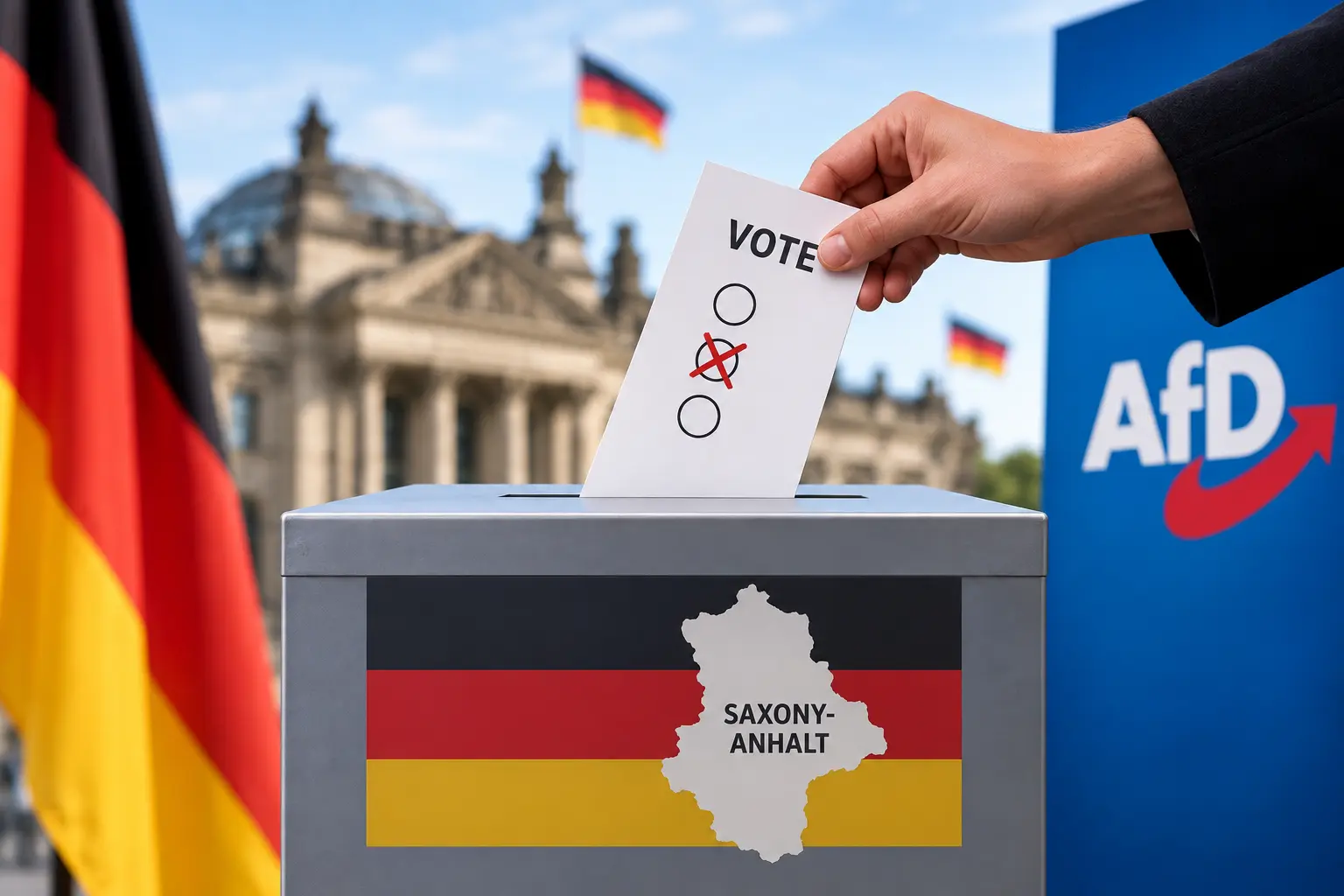
Voters across the eastern German state of Saxony-Anhalt head to the polls on Sunday, September 6, 2026, for a high-stakes state election that carries profound implications for the country's political landscape. This ballot is being watched closely as a potential watershed moment, with the far-right Alternative for Germany party seeking to secure executive power at the state level for the first time since the Second World War. As polling stations prepare to open, the outcome could redefine regional governance and serve as a severe test for federal authorities.
Ulrich Siegmund and the Rise of the AfD in Saxony-Anhalt
The Alternative for Germany has maintained a commanding lead in regional pre-election surveys for months, driven largely by the appeal of its 35-year-old regional leader, Ulrich Siegmund. Recent polling data places the party comfortably ahead at just over 40 percent of the vote. This strong position reflects deep-seated regional discontent and an effective local campaign focused on themes that resonate strongly with eastern voters.
In stark contrast, the Christian Democratic Union, led by federal Chancellor Friedrich Merz, trails significantly behind at approximately 23 percent. Chancellor Merz's administration has attempted to curb the momentum of the far-right movement by adopting much firmer stances on national security and migration control, yet these policy shifts appear to have done little to erode the unwavering support enjoyed by the opposition in Saxony-Anhalt.
The Firewall Policy and the Barrier of Proportional Representation
Securing an absolute majority remains an extraordinarily difficult hurdle within Germany's complex proportional representation electoral system, which was purposefully designed to foster consensus and encourage coalition governments rather than single-party rule. However, analysts note that an outright majority remains mathematically possible for the AfD, particularly if several smaller political parties fail to clear the strict five percent electoral threshold required to enter the state parliament.
Should the party achieve an absolute majority, it would effectively bypass a longstanding political firewall erected by mainstream German parties. Established political forces have maintained a strict policy refusing to enter into coalition government arrangements or cooperate in any official capacity with the AfD, which state security services have classified as a far-right extremist organization. If the party falls short of an outright majority, a Christian Democrat-led administration under incumbent state premier Sven Schulze is considered the most probable alternative, although coalition dynamics remain fraught with tension.