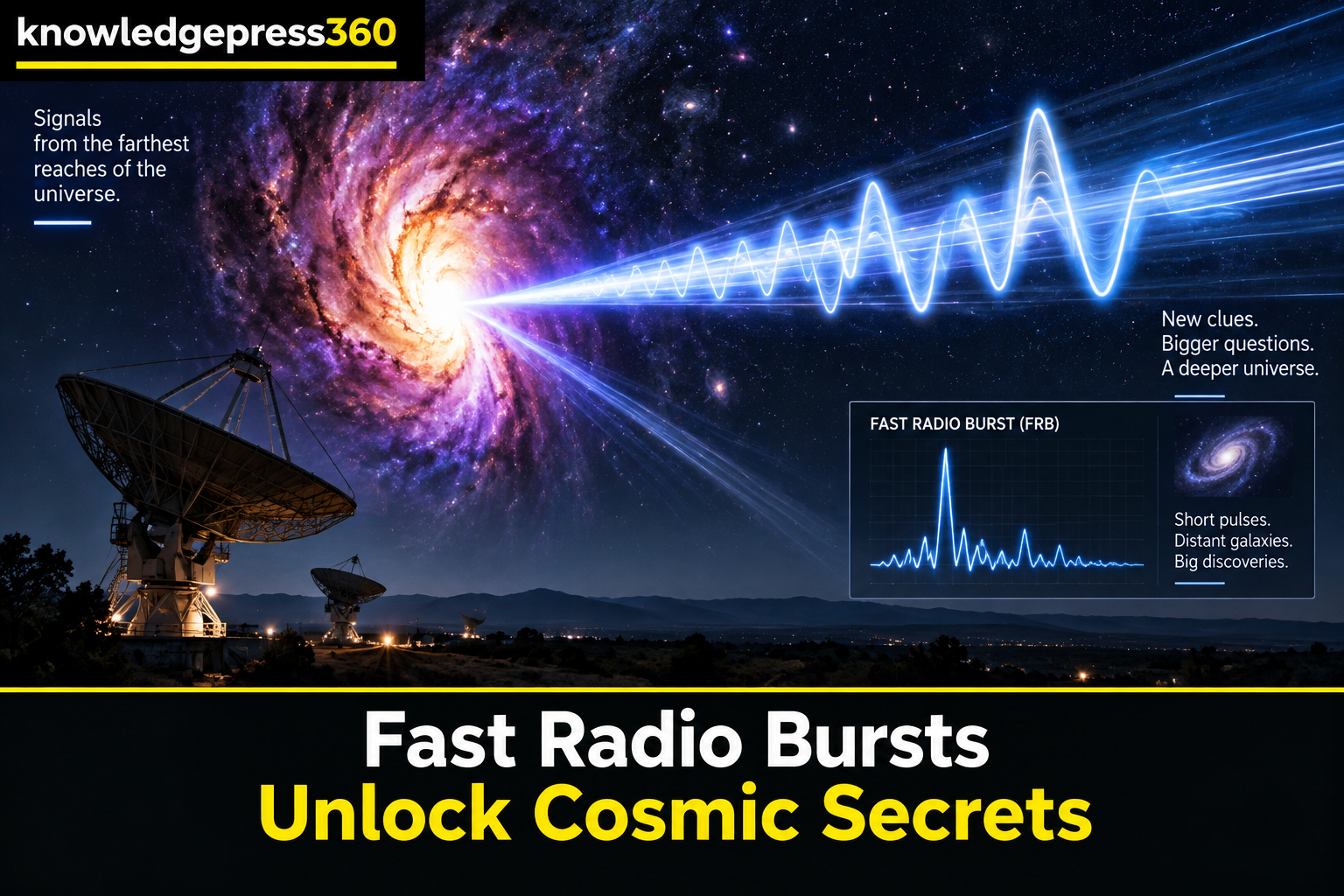
Astrophysicists are transforming enigmatic millisecond-long radio flashes from deep space into powerful diagnostic tools for mapping the universe. Fast radio bursts, which erupt as intense surges of energy before travelling billions of light-years across the cosmos, accumulate distinct signatures from the matter they pass. By examining roughly one hundred of these transient signals, researchers have unlocked a novel method for probing the invisible architecture of the universe. This development matters because conventional techniques struggle to isolate individual galactic influences from broader cosmic expansion, leaving critical gaps in our understanding of dark matter, dark energy, and elusive neutrinos.
Tracing Signals From Magnetars
Fast radio bursts are fleeting, highly energetic blasts of radio waves that current astrophysical models attribute to magnetars, which are dead stellar remnants possessing extreme magnetic fields. As these signals traverse the vast expanses between their distant host galaxies and Earth, they navigate dense clouds of cosmic gas, dust, and intervening galactic structures. This journey acts as a natural filtering process, embedding subtle fingerprints into the original radio waves regarding how ordinary matter is distributed throughout the cosmos.
Researchers at the California Institute of Technology, led by astronomy professor Vikram Ravi and graduate student Kritti Sharma, harnessed approximately one hundred of these recorded events to examine intergalactic matter clumpiness. Ordinary atomic matter accounts for only about five percent of the universe, whereas dark energy comprises sixty-eight percent and dark matter makes up twenty-seven percent. Neutrinos, frequently designated as ghost particles, represent the second most abundant particle type while remaining exceedingly difficult to detect. By capturing the modifications inflicted upon the radio waves during their intergalactic transit, the team successfully demonstrated that these bursts function as premier cosmological probes, offering fresh clarity on the structural composition of the universe.
Measuring Intergalactic Feedback Effects
Analyzing this sample provided the first direct measurement of galactic feedback, which is the energetic outflow ejected from galactic centers by supermassive black holes, and its consequential impact on intergalactic matter clumpiness. The investigation revealed that while galactic feedback actively smooths out surrounding matter, its suppressing effect is measurably weaker than previous estimates suggested. Furthermore, this smoothing signature closely mimics theoretical predictions generated by massive neutrinos, dark matter, and dark energy models.
This overlapping gravitational behaviour introduces a significant analytical challenge for modern cosmology. Because feedback signatures and dark universe dynamics share strikingly similar smoothing profiles, researchers emphasize that accurately accounting for galactic feedback is vital. Without precise separation of these overlapping phenomena, cosmological experiments risk confounding feedback impacts with the broader acceleration and mass characteristics of the dark universe. Consequently, theorists must refine their models to account for this newly quantified intergalactic interference.