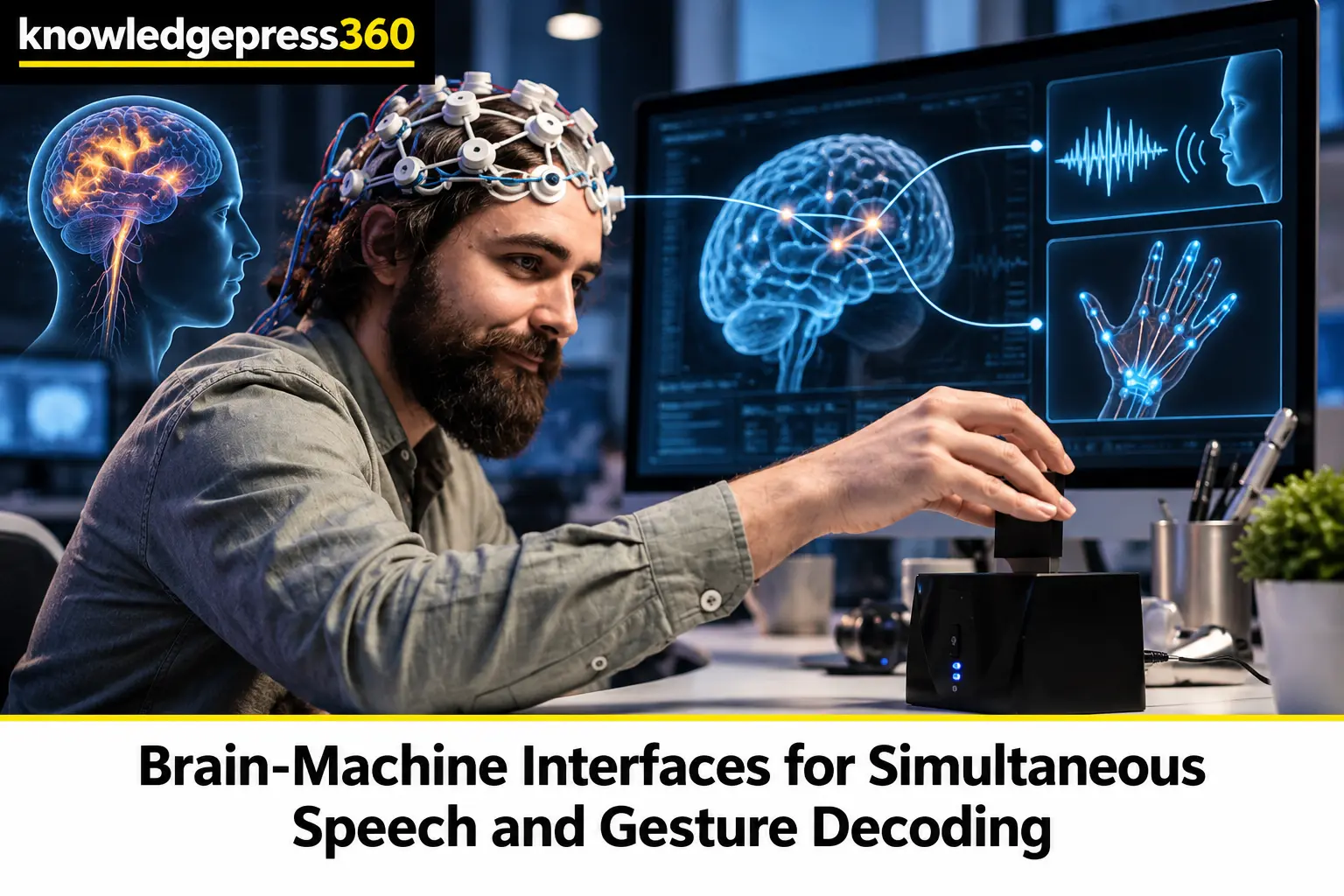
Natural human communication relies on a complex interplay between spoken words and physical gestures. For individuals affected by severe paralysis resulting from stroke or neurodegenerative conditions such as amyotrophic lateral sclerosis, expressing thoughts through this rich combination has historically remained out of reach. While previous advancements in neurotechnology successfully decoded isolated speech or specific limb movements, they fell short of capturing the multimodal reality of everyday conversation. Addressing this long-standing limitation, neurotechnology researchers at the University of California, San Francisco, have developed an innovative brain-computer interface capable of simultaneously decoding speech and upper-body gestures in real time.
Multimodal neural decoding breakthrough
Published on September 14, 2026, and supported by funding from the National Institutes of Health, the study marks a significant leap forward in neuroprosthetic engineering. The research team implanted high-density electrocorticography arrays directly over the sensorimotor cortex of three participants experiencing varying degrees of vocal-tract and bodily paralysis. These arrays recorded neural activity as participants attempted to produce words, phrases, and manual gestures, such as waving or giving a thumbs-up, both independently and concurrently. The resulting neural signals were then translated in real time to control a personalised, full-body virtual avatar. This setup allowed participants to move beyond the laborious constraints of traditional eye-tracking systems and single-effector devices, moving closer to authentic, fluid expression.
Non-linear neural tuning demands
A foundational revelation of the study is that concurrent communication is inherently non-linear. The neural activity generated during the simultaneous production of speech and physical gestures differs substantially from the simple aggregate of isolated patterns. Consequently, decoders trained exclusively on isolated behaviour exhibited degraded performance when faced with mixed expressions. To overcome this hurdle, the scientists deployed sophisticated machine learning models trained specifically on concurrent data, enabling the system to accurately decipher combined thoughts. This distinction proves vital because natural conversation rarely confines itself to isolated motor outputs. By accommodating the overlapping demands placed on the motor cortex, the technology successfully bridges the gap between laboratory instrumentation and authentic human interaction.
Technical limits and trial scope
Despite the promising proof of concept, several important uncertainties remain regarding the broader application of these multi-effector decoders. Long-term stability and reliability of high-density electrocorticography arrays over extended periods of time still require rigorous evaluation outside controlled laboratory settings. Furthermore, researchers must test the generalizability of their multimodal decoders across a significantly larger and more diverse patient cohort. Ensuring that the system maintains its decoding fidelity across varied anatomical differences and progressive neurological declines will dictate whether the technology can transition from experimental trials into widespread clinical availability.