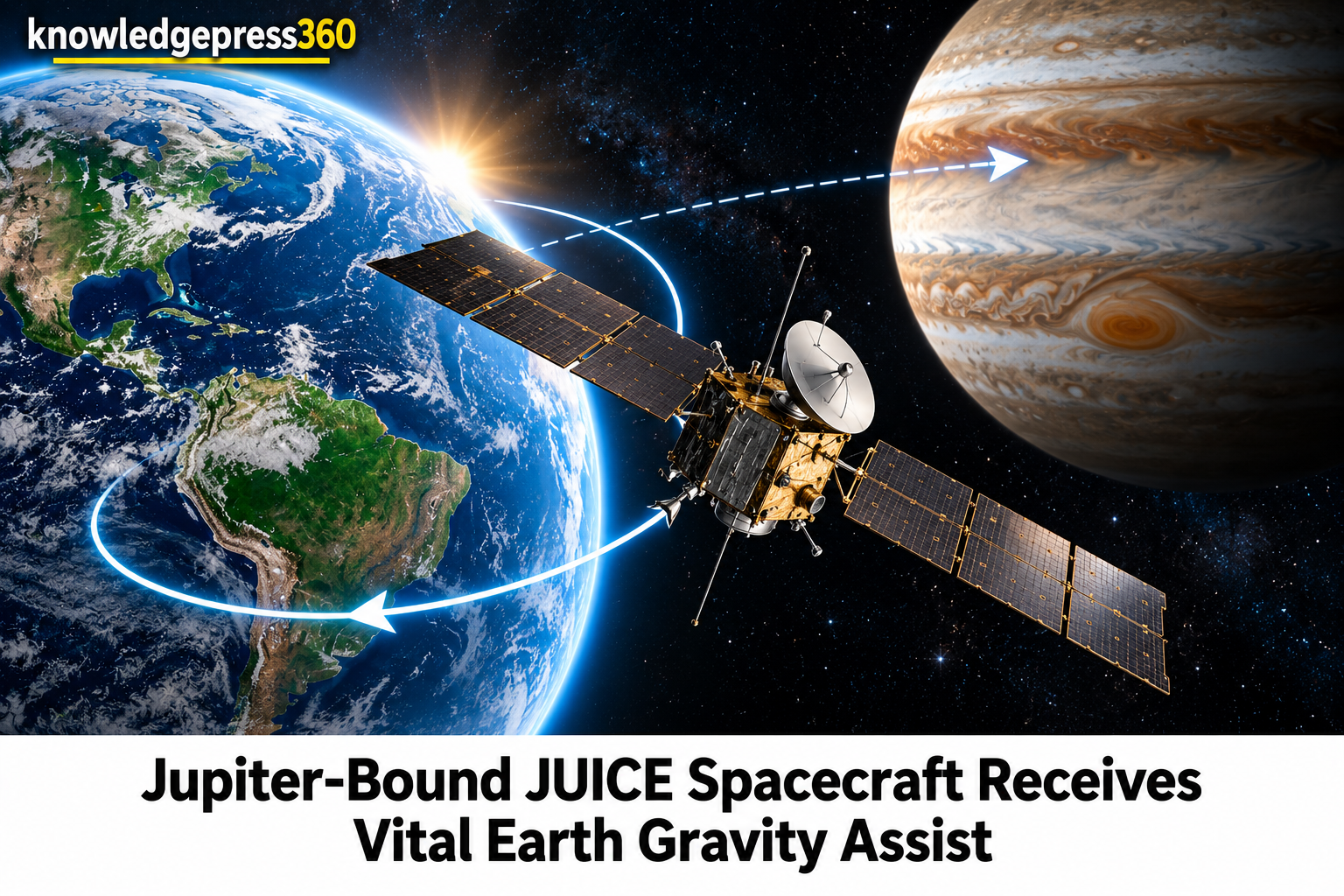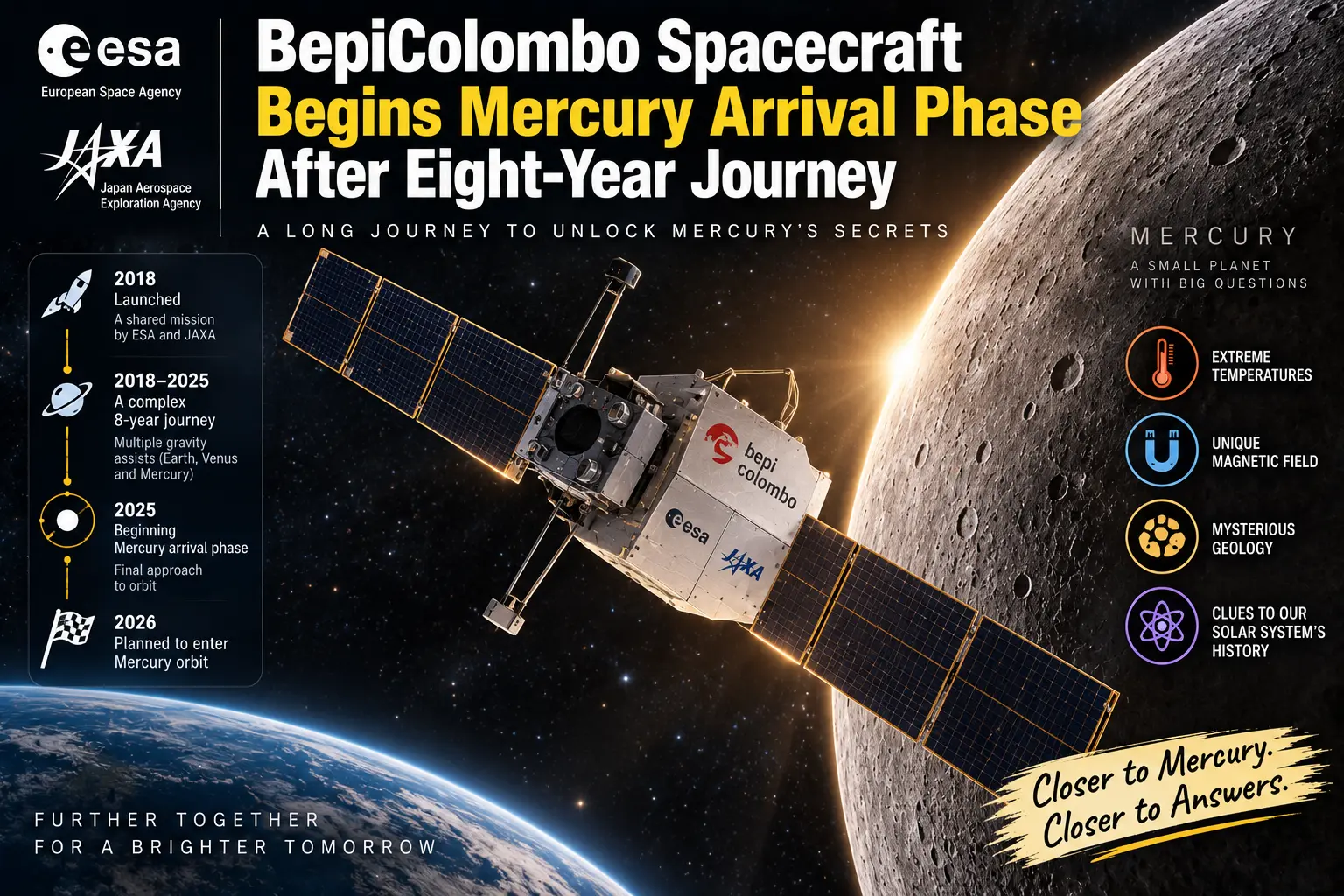
The joint European Space Agency and Japan Aerospace Exploration Agency BepiColombo mission has officially entered its crucial Mercury arrival phase, marking a major milestone for interplanetary exploration. After an arduous eight-year journey through the inner solar system, the spacecraft reached this pivotal juncture when its propulsion unit detached from the primary science orbiters. This complex operational phase initiates the final sequence required to place the probes into orbit around the solar system's innermost and least-explored rocky planet.
Separation of the Mercury Transfer Module From Science Orbiters
The arrival phase commenced on September 3, 2026, when the Mercury Transfer Module successfully separated from the mission's two science orbiters: the European Space Agency Mercury Planetary Orbiter and the Japan Aerospace Exploration Agency Mercury Magnetospheric Orbiter, known as Mio. Launched in October 2018 aboard an Ariane 5 rocket from the Guiana Space Center in French Guiana, the integrated stack relied on the transfer module for power and propulsion throughout its lengthy interplanetary voyage. Mission control at the European Space Operations Centre in Darmstadt, Germany, confirmed the acquisition of signal shortly after the physical separation occurred, validating the initial steps of a delicate orbital capture sequence.
Overcoming Trajectory Constraints and Solar Panel Challenges
Navigating toward Mercury presents immense gravitational and thermal engineering hurdles, as the planet sits deep within the sun's intense gravitational well. To shed excessive orbital energy, BepiColombo executed a carefully calibrated series of planetary flybys, encompassing one encounter with Earth, two with Venus, and six with Mercury itself. The mission timeline faced unexpected friction in April 2024 when a solar panel anomaly reduced power output to the transfer module's electric thrusters. This technical setback forced mission engineers to adopt a lower-thrust trajectory, which subsequently delayed the anticipated Mercury arrival from late 2025 to late 2026. Despite these adjustments, the spacecraft managed its complex trajectory shifts smoothly, leaving minor timing variations as the only residual uncertainty during its cruise phase.
Upcoming Orbital Insertion and Science Operations Schedule
Following their separation, the two remaining science orbiters are journeying together for their final approach toward the planet. The combined probes are scheduled to achieve orbital insertion around Mercury on November 21, 2026. This milestone will trigger a demanding sequence of sixteen distinct maneuvers designed to reshape their trajectory. On December 9, 2026, the Mio spacecraft will detach to settle into its designated polar orbit, while the Mercury Planetary Orbiter will adjust its own trajectory to enter a separate polar orbit by March 2027. Comprehensive science operations are slated to officially commence on April 6, 2027, enabling researchers to investigate the planet's surface composition, internal geology, magnetic field, and solar wind interactions.