A Month of Celestial Fireworks
August 2026 is shaping up to be one of the most rewarding months for anyone who enjoys looking up. Within a span of three weeks the night sky will host a total solar eclipse, the annual Perseid meteor shower at its peak, Venus at its brightest evening apparition, and a deep partial lunar eclipse. Each event offers a different kind of spectacle and a set of practical considerations for safe, rewarding observation.
12 August: Total Solar Eclipse Across the North
The headline of the month is the total solar eclipse that sweeps across the high latitudes of northern Russia, Greenland, Iceland and the northern fringe of Spain, with a small sliver of Portugal also falling inside the path of totality. In the United States the eclipse will be seen as a partial event, ranging from a thin bite in Alaska to a more substantial covering in the Carolinas.
During totality the Moon completely blocks the Sun’s photosphere, turning day into a brief twilight and revealing the Sun’s faint corona. The eclipse will begin at approximately 09:45 UTC and reach maximum coverage around 10:30 UTC for locations on the centre line. Observers outside the path will still witness a partial eclipse, with the fraction of the Sun obscured varying with latitude.
How to Watch Safely
Never look directly at the Sun without proper protection. Certified eclipse glasses or a solar‑filter‑equipped viewer are essential any time the Sun is exposed, even during a partial phase. Regular sunglasses, smoked glass or unfiltered telescopes, binoculars or cameras can cause permanent eye damage. If you plan to photograph the event, attach a solar filter to the front of the optical instrument rather than the eyepiece.
12‑13 August: Perseid Meteor Shower Peak
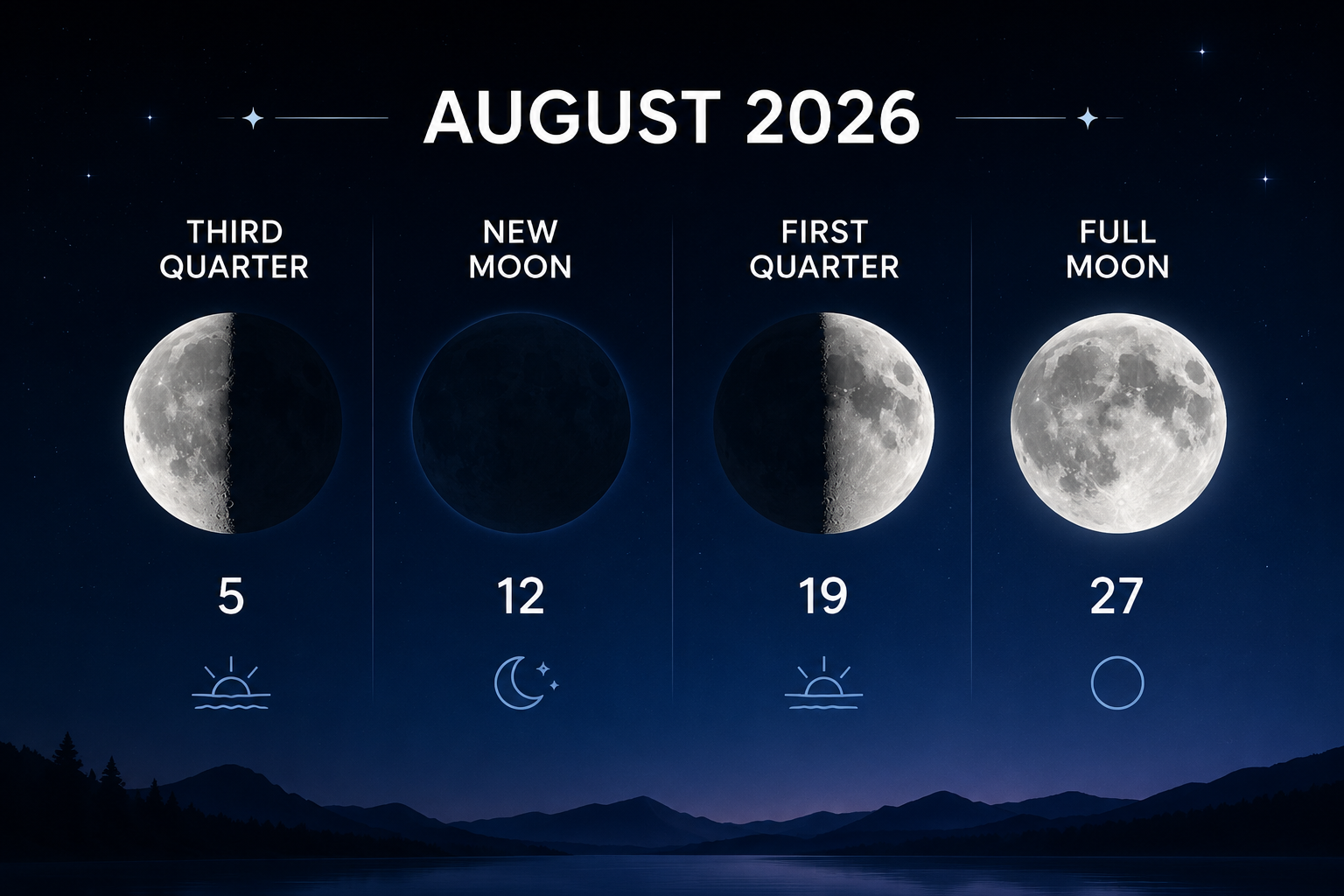
Just hours after the eclipse, the Perseid meteor shower reaches its zenith. The shower peaks during the early hours of the night on the 13th, benefitting from the new Moon that occurs on the 12th – a dark sky that maximises visibility of faint meteors.
The Perseids are the result of Earth moving through a dense stream of dust left by Comet Swift‑Tuttle. When those tiny particles enter the atmosphere they vaporise, creating bright streaks that appear to radiate from the constellation Perseus, which will be just above the eastern horizon after astronomical twilight.
Viewing Advice
- Location: Find a dark, open site away from streetlights; the more of the horizon you can see, the better.
- Orientation: Start by looking toward the northeast where Perseus rises, but allow your eyes to wander – meteors can blaze across any part of the sky.