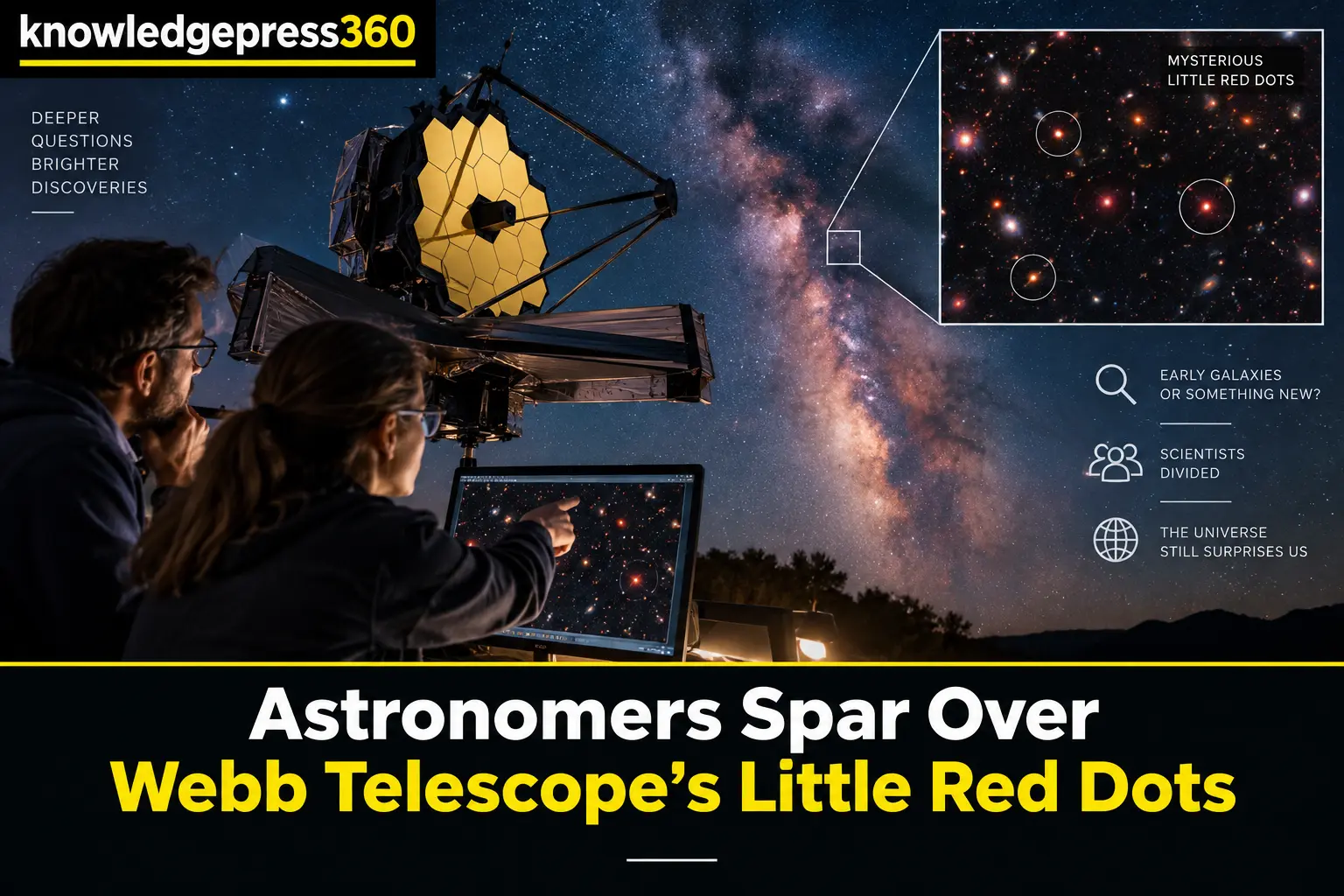
When the James Webb Space Telescope began returning its earliest observations of the cosmos, researchers anticipated glimpses of infant galaxies forming during the dawn of time. Instead, the orbiting observatory revealed an unexpected population of compact, highly luminous red objects scattered across the early universe. These enigmatic pinpricks of light, quickly dubbed little red dots, immediately challenged conventional astrophysical timelines. Initially misinterpreted as exceptionally distant and oversized galaxies, deep spectroscopic surveys soon indicated that these dense sources bore a striking resemblance to supermassive black holes rather than standard stellar congregations. The debate over their true physical nature has since ignited one of the most intense controversies in modern observational astronomy.
Discovery of Little Red Dots
The peculiar objects emerged in data captured roughly six hundred million years after the Big Bang, defying theoretical expectations regarding how quickly massive structures could assemble. Spanning merely a single pixel in many frames yet radiating with the blinding luminosity of an entire galaxy, these crimson anomalies appeared with surprising frequency in deep-field exposures. Researchers examining spectroscopic signatures realized that the intense radiation was not generated by normal star formation. Instead, the formidable gravitational pull of central black holes violently vacuuming up surrounding gas and dust seemed a far more likely engine. Yet these sources possessed peculiar properties that distinguished them from ordinary quasars, leaving scientists searching for an explanation that could account for both their compact size and their extraordinary brightness.
The Black Hole Star Hypothesis
To resolve these anomalies, researchers proposed a radically novel astronomical phenomenon known as the black hole star model. This framework suggests that little red dots consist of a rapidly accreting supermassive black hole enveloped within a dense, optically thick cocoon of partially ionized gas. This protective shroud absorbs and reprocesses radiation, creating the distinct crimson signature detected by instruments on the space telescope. A major breakthrough for this hypothesis arrived when a research team led by Vasily Kokorev analyzed the deepest spectrum to date of a little red dot designated as GLIMPSE-17775, which was magnified via gravitational lensing behind the massive galaxy cluster Abell S1063. The team identified more than forty distinct spectral lines that aligned with predictions of the black hole star model, offering the most comprehensive observational support yet compiled for the scenario.
Evidence From CANUCS LRD z8 6
Further reinforcing the connection between these enigmatic sources and early black hole growth, independent teams studying the galaxy CANUCS-LRD-z8.6 confirmed the presence of an actively growing supermassive black hole existing just five hundred and seventy million years after the Big Bang. Led by researchers utilizing the telescope's Near-Infrared Spectrograph, the investigation detected key spectral features pointing to rapid mass accumulation. This growing behemoth was found to be expanding far faster than standard models of early cosmic co-evolution would predict. Such discoveries complicate prevailing theories by demonstrating that massive black holes managed to amass enormous mass long before their host galaxies had time to properly mature, forcing theorists to rethink the fundamental mechanics of early black hole growth.