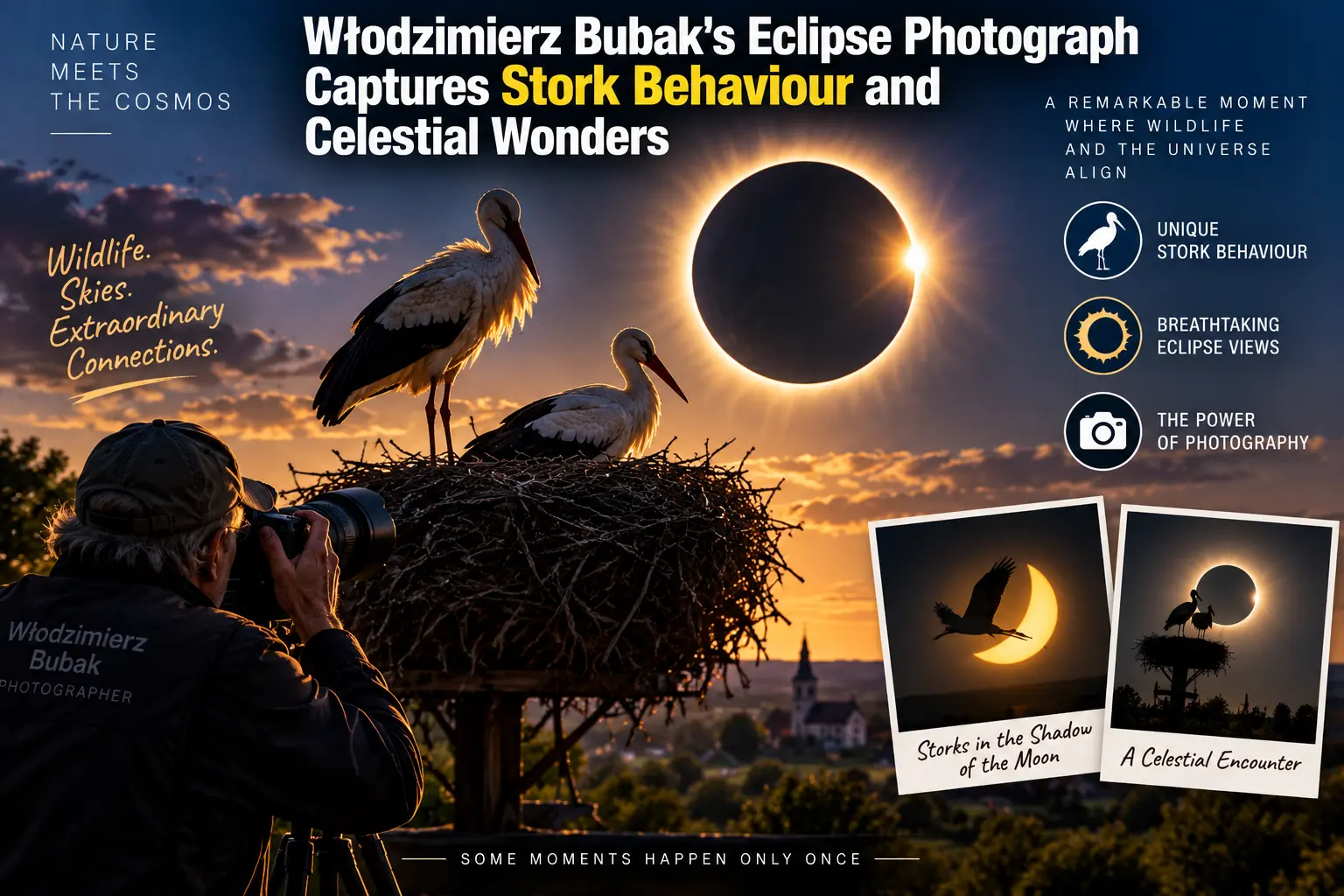
The intersection of cosmic alignments and earthly wildlife responses provides astronomers and biologists with a compelling window into natural rhythms. Published on September 3, 2026, a striking Astronomy Picture of the Day from NASA captured by photographer Włodzimierz Bubak immortalised a stork roosting on its nest in Poland during the partial phase of a recent total solar eclipse. This visual document serves as more than an astronomical snapshot. It highlights the immediate influence that sudden celestial darkness exerts on animal behaviour across diverse ecosystems, reminding observers of the interconnected nature of biological and astronomical events.
Włodzimierz Bubak Photographs Stork Behaviour During Polish Solar Eclipse
The featured image from early September turns scientific focus toward the subtle ways fauna react when the Moon temporarily obscures the solar disk. Observers situated in quiet, natural environments during total solar eclipses frequently document a shift in ambient soundscapes and animal activity. As totality descends, daytime noises fade, replaced by the nocturnal chorus of crickets and frogs, alongside the emergence of fireflies. Avian species display distinct responses as darkness falls mid-afternoon. Most birds grow quiet, while ducks and various waterfowl instinctively prepare for rest, tucking their heads toward their back feathers under the impression that night has fallen. Once the alignment shifts and direct sunlight breaks through the lunar shadow once more, songbirds greet the premature morning with traditional dawn melodies, prompting the nocturnal insects to fall silent and allowing normal diurnal routines to resume.
September Stargazing Highlights Feature Andromeda Galaxy Observations
Beyond atmospheric animal reactions, early September 2026 offers opportunities for celestial observation across the northern hemisphere. Stargazers tracking seasonal night sky calendars note that the Andromeda Galaxy, designated M31, occupies an ideal position for evening viewing. Located between the prominent constellations of the Great Square of Pegasus and Cassiopeia, our neighbouring spiral galaxy becomes discernible through binoculars or small telescopes on clear autumn nights. These routine astronomical alignments complement the broader public fascination driven by solar eclipses, maintaining engagement between professional researchers, amateur astronomers, and the wider public.
Empirical Limits in Molecular Biology Contrast With Cosmic Precision
While celestial mechanics allow scientists to predict planetary movements and solar alignments with high accuracy, parallel developments in molecular biology demonstrate the boundaries of modern predictive science. Research published in September 2026 investigated the bacteriophage ΦX174, a virus whose simple circular genome containing 5,386 nucleotides has served as a foundational model for virology since its early sequencing and synthesis milestones. In this recent study, researchers systematically introduced mutations across nearly every individual nucleotide and amino acid to map viral fitness. The findings revealed that approximately one-quarter of the mutations proved fatal to the virus for reasons that cutting-edge artificial intelligence models failed to anticipate. Led by molecular biologists such as Ben Lehner at the Wellcome Sanger Institute, the work underscores that even in studied systems, advanced computational algorithms still struggle with complex biological forecasting, necessitating continued reliance on empirical experimentation.