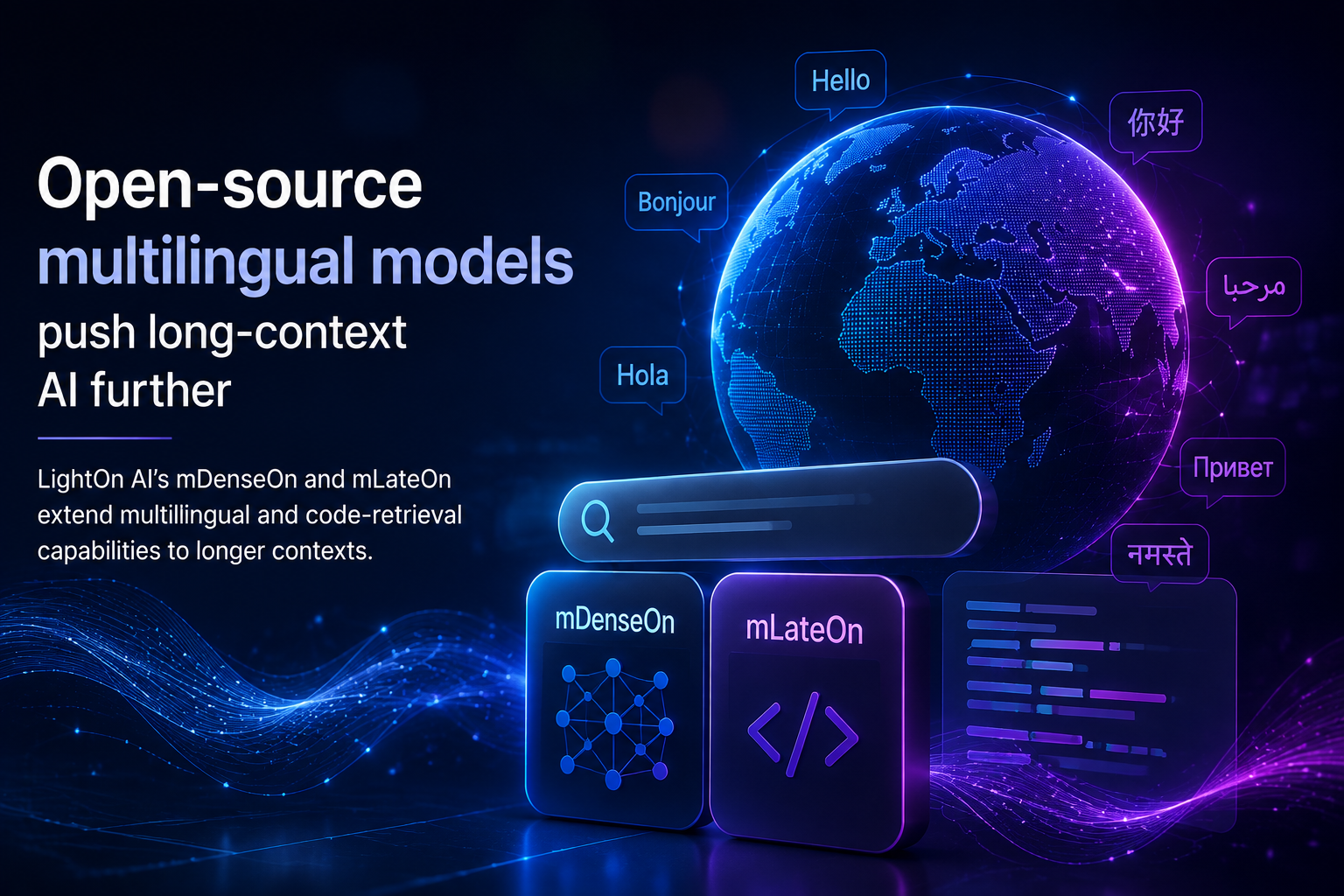
Extending the reach of open‑source multilingual AI
LightOn AI announced two new models – mDenseOn and mLateOn – on the Hugging Face model hub. Both are built to handle multilingual text, longer input windows, and code‑related retrieval tasks, all under an open‑source licence. By publishing the models publicly, LightOn joins a growing cohort of organisations seeking to lower the barrier for researchers and developers who need robust, language‑agnostic tools without the expense of proprietary services.
From dense to late‑fusion retrieval: the technical leap
The mDenseOn family follows the dense‑retrieval paradigm, encoding queries and documents into a shared vector space. What sets it apart is the explicit optimisation for multilingual corpora, allowing a single model to index and retrieve across dozens of languages. This contrasts with many existing dense models that are trained on monolingual data and require separate instances for each language.
In parallel, mLateOn adopts a late‑fusion architecture. Rather than merging query and document representations early, the model first processes each side independently and only combines them at a later stage. This design improves performance on code‑retrieval benchmarks, where syntax and semantics differ sharply from natural language. Early tests reported by LightOn suggest that mLateOn can retrieve relevant code snippets from multilingual repositories more accurately than earlier open‑source baselines.
Long‑context handling without sacrificing speed
Both models are engineered to accept inputs longer than the typical 512‑token limit that constrains many transformer‑based systems. By extending the context window, developers can feed entire paragraphs, multi‑turn dialogues, or sizeable code files into a single forward pass. LightOn reports that the architecture leverages efficient attention mechanisms to keep inference times competitive, a crucial factor for real‑time applications such as interactive assistants or code‑completion tools.
Democratising AI research through open science
The release aligns with Hugging Face’s broader mission to advance and democratise artificial intelligence via open source and open science. By hosting the models on the platform, LightOn ensures that the community can fine‑tune, benchmark, and integrate them into downstream pipelines without licensing hurdles. This openness encourages reproducibility, a persistent challenge in AI research, and invites contributions that may further improve multilingual coverage or adapt the models to specialised domains.