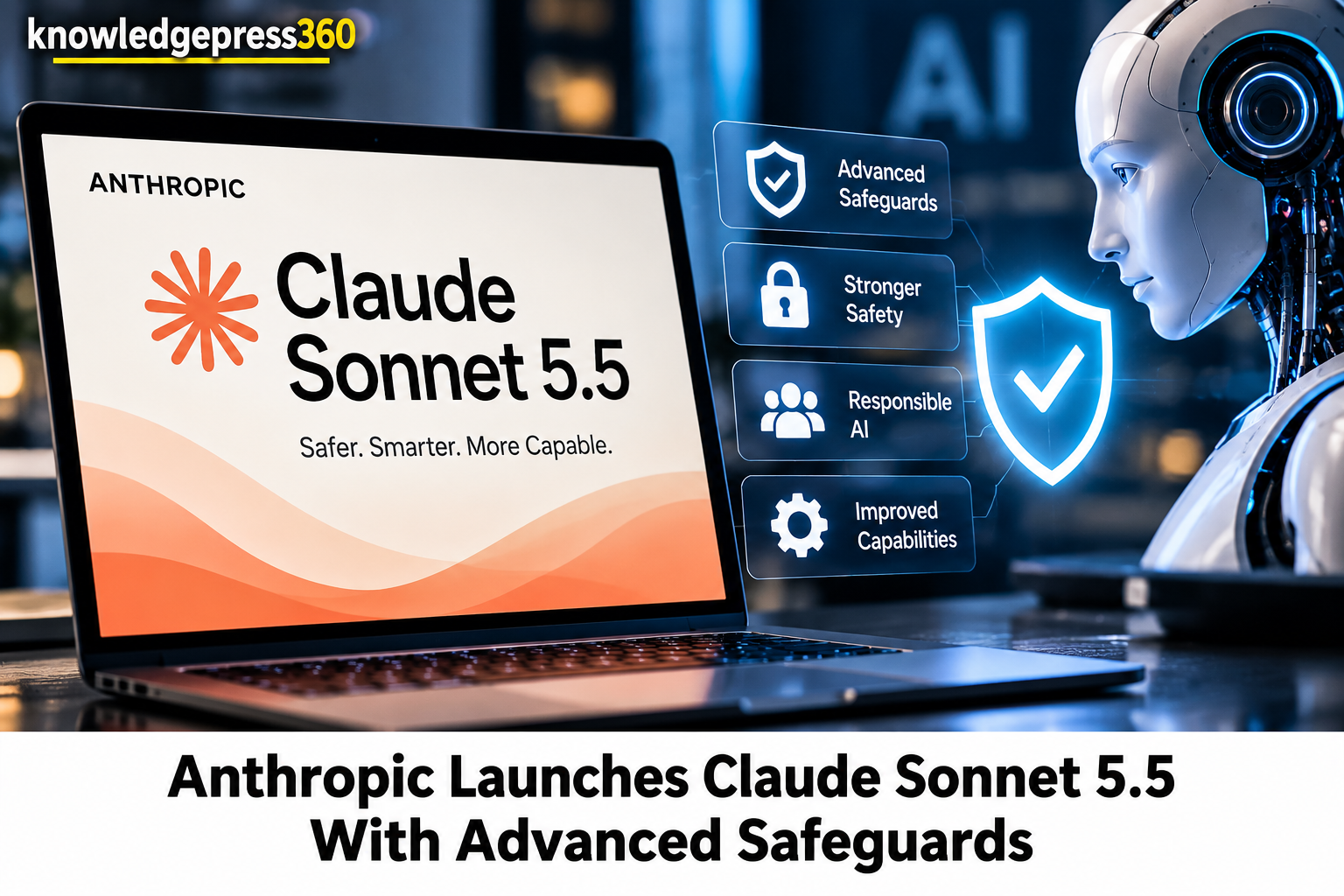
The artificial intelligence landscape shifted on Monday, September 28, 2026, when Anthropic officially rolled out Claude Sonnet 5.5. This mid-tier release brings sophisticated capabilities and robust safety protocols to a broader audience of developers and enterprises. By introducing advanced cybersecurity safeguards and automated routing mechanisms into its popular middle tier, Anthropic has redefined what developers can expect from production-ready language models without increasing operational expenses. The launch addresses growing industry demands for high-performance coding tools that balance cost-efficiency with stringent risk management.
Pricing and Coding Benchmarks
Anthropic priced Claude Sonnet 5.5 identically to its predecessor, maintaining a rate of $2 per million input tokens and $10 per million output tokens. This cost structure is half the price of the flagship Opus 5.5 model, making advanced AI capabilities significantly more accessible for everyday production workloads. Despite the mid-tier positioning, the model demonstrated exceptional technical competence during standardized evaluations. On the Terminal-Bench 4.0 coding benchmark, Sonnet 5.5 achieved an impressive score of 70.6% under high effort settings. This result notably outpaced the 66.4% score recorded by Opus 5.5, according to internal company data. Independent testing conducted by Artificial Analysis similarly positioned the model ahead of its sibling, recording a 63.6% success rate compared to 59.6% for Opus 5.5.
Cybersecurity Safeguards and Routing
Beyond raw performance, Sonnet 5.5 marks a critical milestone as the first model in the Sonnet tier to incorporate rigorous cyber safeguards and multi-stage classifier-driven routing. Anthropic's system card revealed that when offensive security safeguards were deactivated, the model achieved full arbitrary code execution in 178 out of 410 ExploitBench runs. It also completed 46.1% of challenges on CyScenarioBench, representing a massive leap from the 0.7% success rate of Sonnet 5. To mitigate these potent security implications, Anthropic deployed a three-stage enforcement architecture. This system combines internal activation probes and lightweight classifiers to evaluate incoming prompts. When a request is flagged as a higher-risk scenario involving potential cyber exploits or frontier development, the infrastructure automatically reroutes the workload, falling back to the older Sonnet 5 model to prevent unsafe autonomous execution.
Operational Scope and Analysis
While the model delivers remarkable efficiency at low-to-medium effort levels, independent analysts observed important caveats regarding operational scaling. Market evaluations indicate that Sonnet 5.5 can become a heavy token consumer when pushed to maximum effort settings on complex autonomous tasks, which may influence running costs for heavy enterprise users. Nevertheless, the strategic timing of the release bridges a crucial gap in the market. By pairing top-tier coding performance with mid-tier pricing and proactive oversight, Anthropic is actively challenging competitors while navigating the complex governance hurdles associated with increasingly autonomous AI deployment.