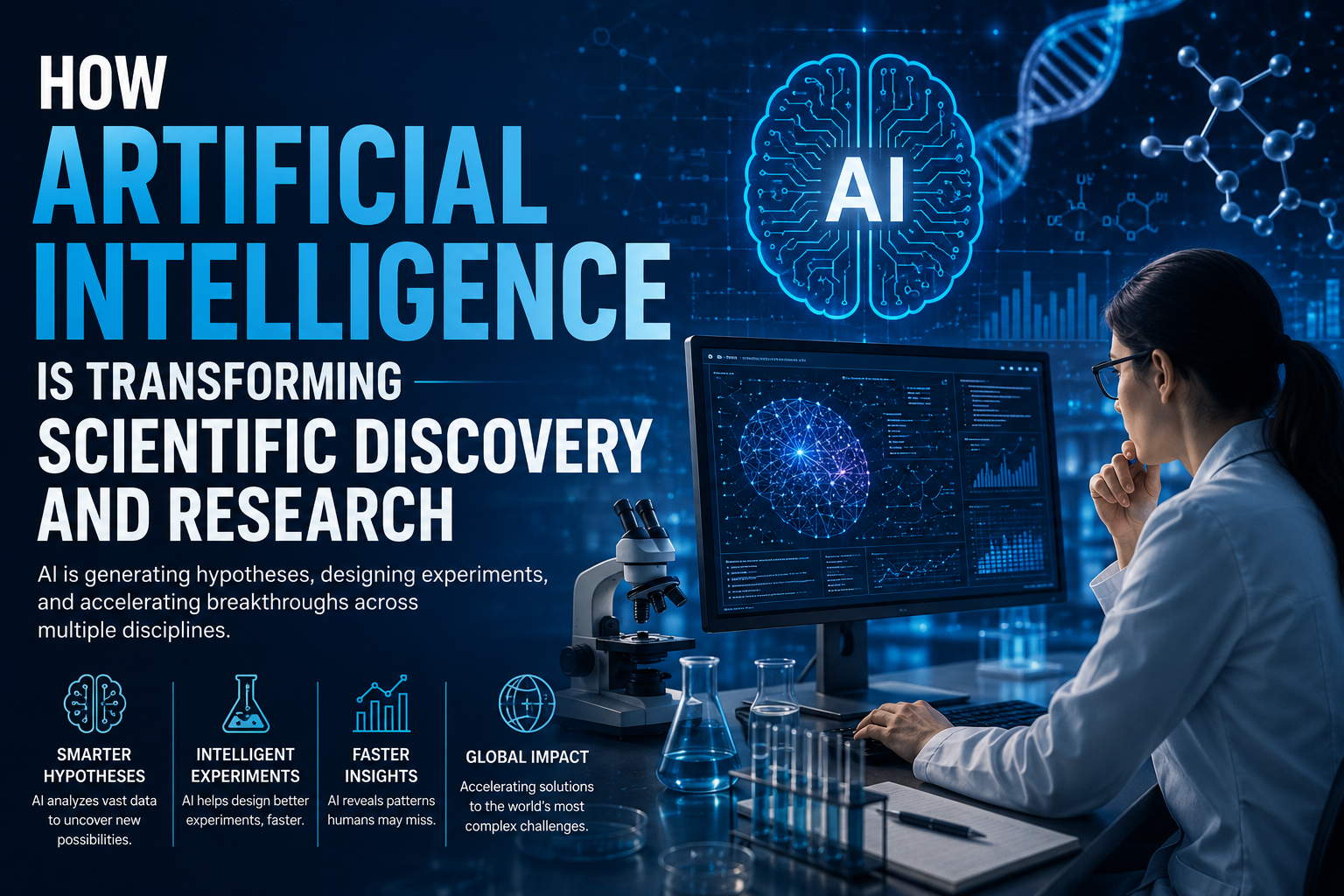
Artificial intelligence is beginning to reshape not only how scientists analyse information, but how research itself is conducted. Advanced AI systems can now search scientific literature, identify patterns across enormous datasets, propose testable hypotheses and assist with experimental design. Stanford researchers describe this emerging generation of tools as capable of supporting scientists across multiple stages of the discovery process, from literature review and hypothesis generation to data interpretation and validation. Rather than replacing researchers, these systems are increasingly functioning as computational collaborators that can extend the scale and speed of human investigation.
Some of the clearest evidence of this transition has emerged in biomedical research. In 2026, researchers reported Co-Scientist, a Gemini-based multi-agent system designed to generate and refine scientific hypotheses through repeated cycles of generation, critique, ranking and improvement. Published in Nature, the system demonstrated how AI agents can help researchers explore potential explanations for complex scientific problems and develop proposals for experimental verification. Another Nature study introduced Robin, a multi-agent platform capable of combining literature searches, hypothesis generation, experimental planning and data analysis within a connected research workflow. These developments suggest that AI is progressing from being a passive analytical tool toward participating in several stages of the scientific method.
Stanford researchers are pursuing a similar approach through Biomni, an AI biomedical research agent that brings together specialised scientific tools, databases and software packages. Stanford HAI reports that researchers can use the system for tasks including gene prioritisation, drug repurposing, rare-disease analysis, literature review and wet-lab experiment design. By automating repetitive computational work and connecting fragmented research resources, systems of this kind could allow scientists to spend more time evaluating results, designing meaningful questions and carrying out physical experiments.
Artificial intelligence has already demonstrated significant value in structural biology. Google DeepMind's AlphaFold transformed protein-structure prediction and has since become a widely used scientific research tool. AlphaFold 3 expanded these capabilities to modelling interactions involving proteins, DNA, RNA, ligands and other biomolecules, potentially assisting research into disease mechanisms and drug development. DeepMind has also introduced tools such as AlphaGenome for studying how genetic variants affect gene regulation and AI systems intended to support scientific hypothesis generation. Together, these technologies illustrate how specialised AI can help researchers navigate biological complexity that would otherwise require enormous amounts of experimental and computational effort.
AI is also beginning to assist researchers with the computational infrastructure of science itself. A 2026 Nature study described an AI system called Empirical Research Assistance, or ERA, which creates and improves scientific software for computational experiments. In reported tests, the system developed methods for single-cell analysis and epidemiological forecasting that performed competitively against established approaches. Such systems could reduce one of modern research's persistent bottlenecks: the time required to develop, test and optimise specialised scientific software.