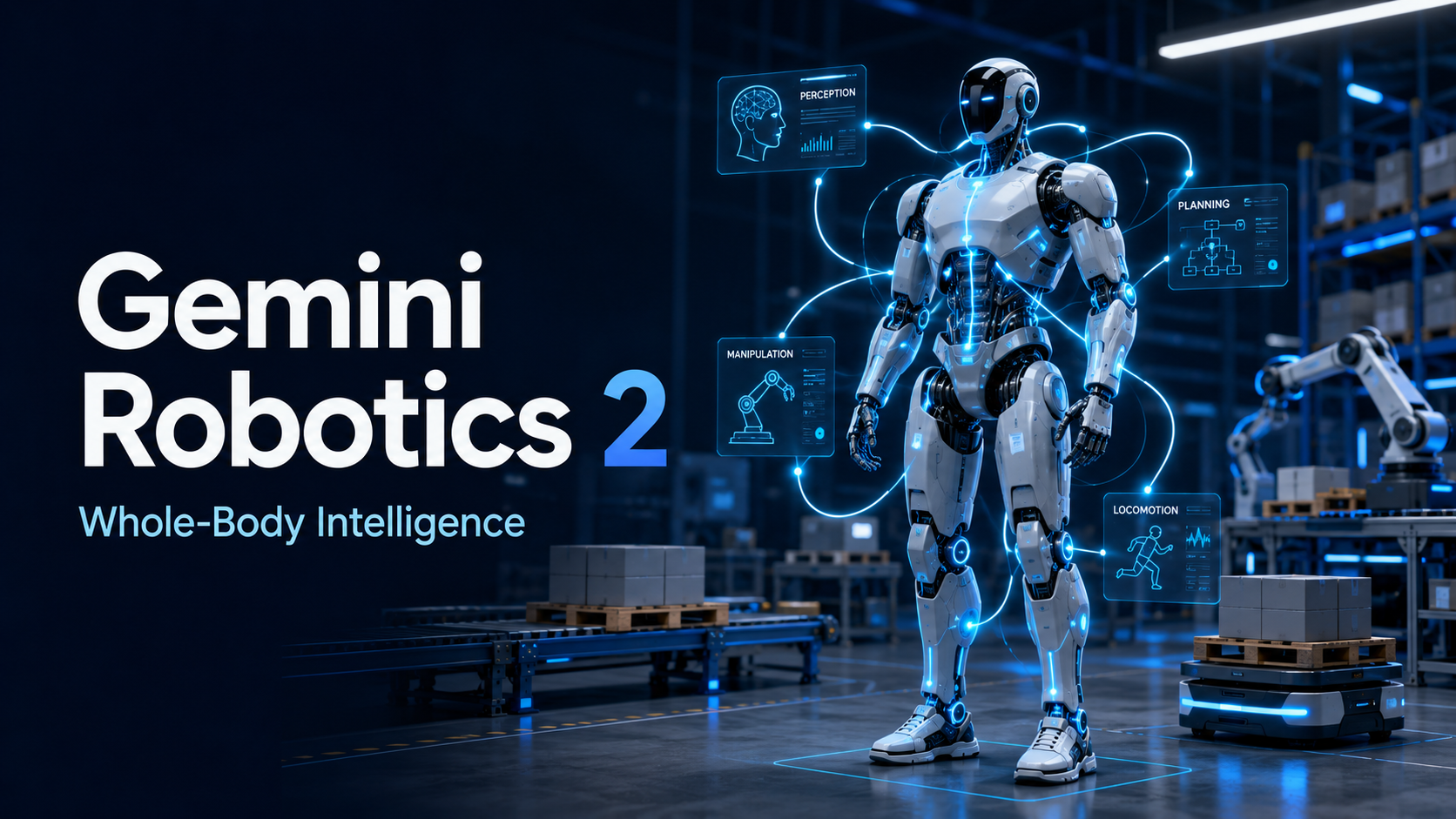
The next leap in industrial automation may not come from a new robotic arm or sensor, but from machines capable of understanding and coordinating their entire bodies. DeepMind’s Gemini Robotics 2 introduces a new approach to robotics by combining perception, reasoning and movement into a unified intelligence framework. The system represents a shift away from narrowly programmed robotic actions toward machines that can interpret instructions, adapt to changing environments and perform complex physical tasks with greater flexibility [1].
By extending artificial intelligence beyond digital environments and into the physical world, Gemini Robotics 2 highlights a future where robots could support manufacturing, warehouse operations, research laboratories and service environments. While the technology remains in an early stage, its development demonstrates how AI is moving from software assistants toward embodied systems capable of interacting with real-world environments.
From Isolated Modules to Integrated Agency
Traditional industrial robots usually depend on separate systems working together. Cameras collect information, planning algorithms decide movements, and controllers execute physical actions. Although this approach has enabled modern automation, it often makes robots difficult to adapt when conditions change.
Gemini Robotics 2 introduces a more integrated approach through vision-language-action models that connect what a robot sees, understands and does. Instead of separating perception, reasoning and movement into disconnected processes, the system allows robots to interpret visual information, understand instructions and generate physical actions within a unified AI framework. [1]
The Gemini Robotics ecosystem includes different intelligence layers. Gemini Robotics provides action capabilities, Gemini Robotics-ER 2 supports higher-level reasoning and planning, while Gemini Robotics On-Device 2 enables local processing directly on robotic hardware. Together, these systems allow robots to analyse environments, complete multi-step tasks and adjust their behaviour based on changing conditions. [1][2]