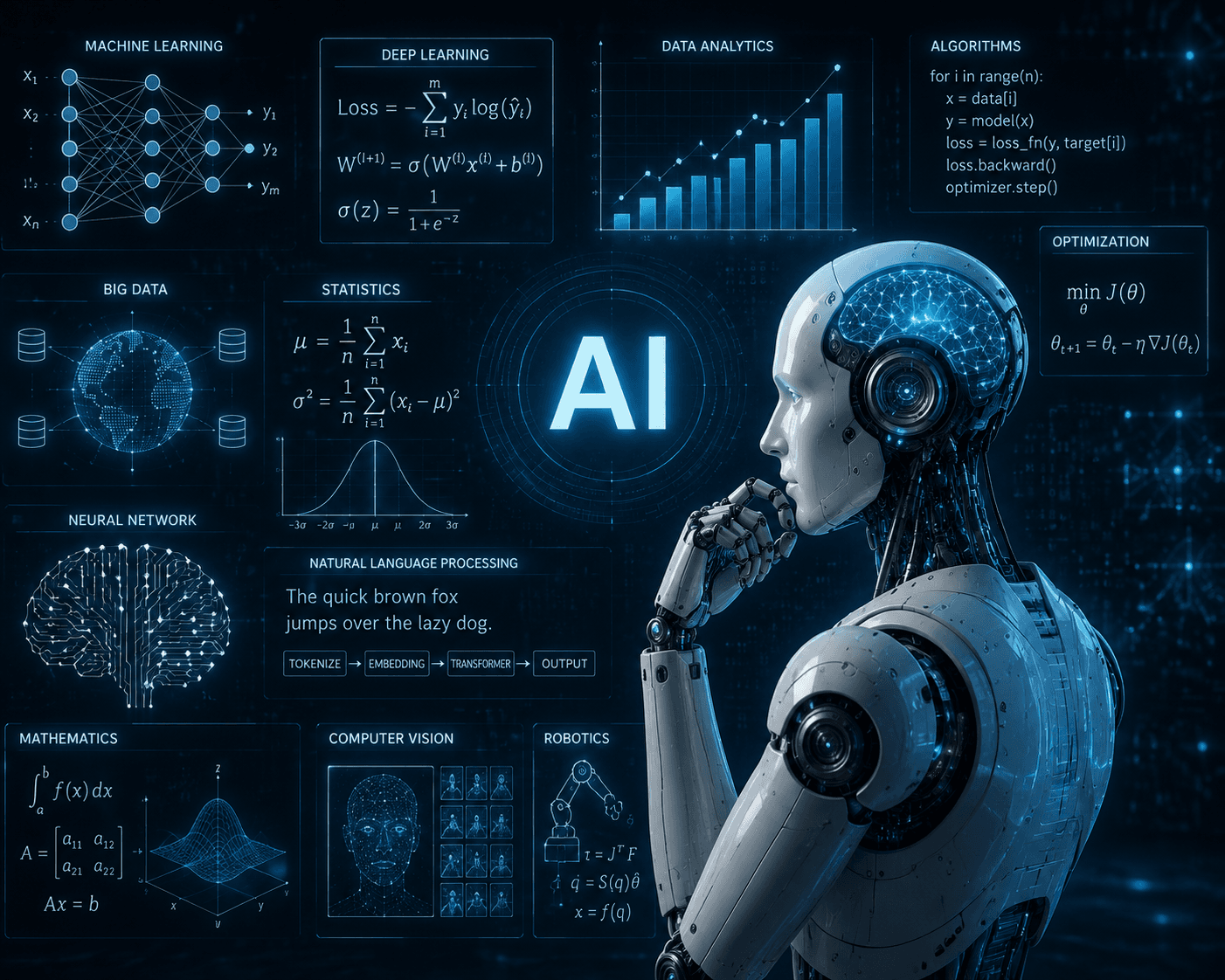
Artificial Intelligence (AI) has entered a transformative era, evolving from a specialized research field into a foundational technology that is reshaping industries, scientific discovery, education, healthcare, and everyday life. The rapid pace of innovation over the past few years has accelerated the development of increasingly capable AI systems that can reason, generate content, write software, analyze complex data, and assist with decision-making. Today, AI is no longer viewed merely as a productivity tool; it has become a general-purpose technology comparable to the internet and electricity in its potential to transform society.
This article explores the latest breakthroughs in AI, the technologies driving these advancements, their real-world applications, the challenges that remain, and the future direction of artificial intelligence.
The Rise of Foundation Models
One of the most significant developments in modern AI is the emergence of foundation models. These large-scale neural networks are trained on enormous datasets and can perform a wide range of tasks without requiring separate models for each application.
Modern AI systems now demonstrate remarkable capabilities, including:
- Natural language understanding and generation
- Advanced reasoning and problem solving
- Software development and debugging
- Image, audio, and video generation
- Scientific data analysis
- Mathematical reasoning
- Multilingual communication
- Autonomous task execution
These capabilities have enabled AI systems to become valuable assistants for researchers, engineers, educators, healthcare professionals, and businesses worldwide.
Multimodal Intelligence
Recent AI models are no longer limited to processing text alone. Instead, they can understand and generate multiple forms of information simultaneously, including images, audio, video, documents, and code.
Multimodal AI enables applications such as:
- Medical image interpretation
- Document understanding
- Real-time translation
- Interactive tutoring
- Robotics
- Autonomous vehicles
- Visual question answering
- Video generation
The integration of multiple data modalities allows AI to better understand context, resulting in more natural and intelligent interactions.
AI Agents: Beyond Chatbots
A major trend in 2026 is the rise of AI agents. Unlike traditional chatbots that simply respond to prompts, AI agents can plan, reason, execute multi-step tasks, use external tools, browse information, write code, and collaborate with humans.