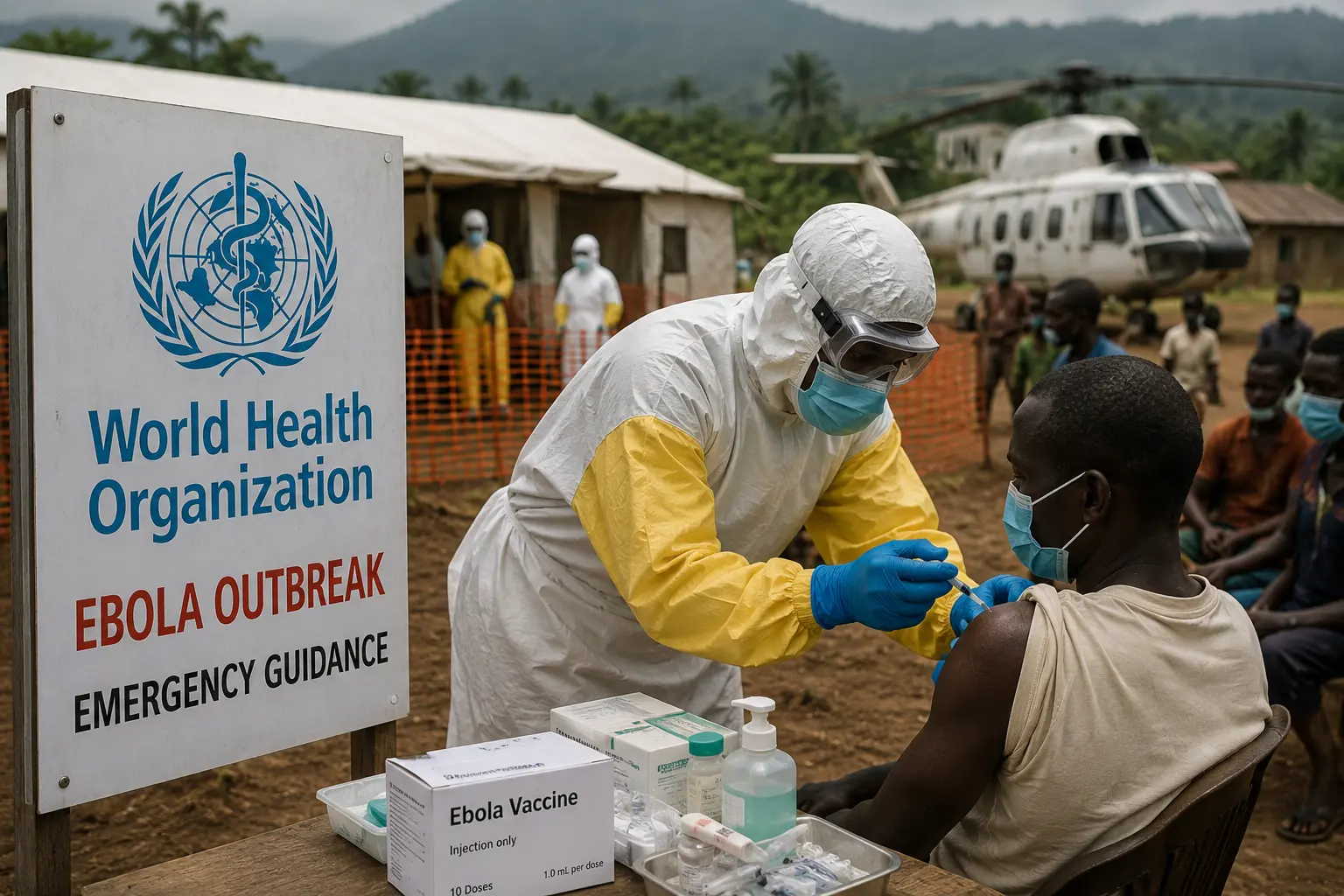
Public health authorities are navigating a critical intersection of viral hemorrhagic fever management following updated international directives and cross-border outbreak evaluations. The World Health Organization has released vital emergency recommendations addressing the potential off-label administration of licensed Ebola vaccines during active transmissions of the Bundibugyo virus [1]. Concurrently, public health agencies have scrutinised the operational dynamics of recent transboundary outbreaks to refine regional preparedness frameworks [3]. These developments highlight both the urgency of deploying medical countermeasures against neglected viral strains and the complex administrative hurdles that test containment capacities in resource-limited settings.
World Health Organization Issues Emergency Guidelines for Ervebo During Bundibugyo Outbreaks
The World Health Organization formally issued updated emergency guidance addressing the off-label deployment of Ervebo, currently the sole licensed Ebola vaccine, during outbreaks driven by the Bundibugyo virus [1]. Operating through evaluations conducted by the Strategic Advisory Group of Experts on Immunization, health officials reviewed comprehensive animal models, immunological assays, and observational metrics [1]. The panel concluded that while certain preliminary findings hint at potential cross-reactive immunity, existing evidence remains fundamentally insufficient to verify whether Ervebo delivers clinically meaningful protection for human populations exposed to the Bundibugyo strain [1]. Consequently, international health advisors have stipulated that the vaccine must not be distributed indiscriminately but rather administered strictly within formalized research protocols, such as ring randomized controlled trials [1].